

A friendly gesture by a couple of neighbors of bringing over a few bags of slightly fading vegetables, and then my swapping some back, has become a full-fledged food mini-ministry.
A friend of the family who was an active parishioner at St. Patrick’s Church, the late Dorothy Cardarelli, began going to a veggie giveaway at the Hudson church each Tuesday and delivering some to five families around our north Hudson neighborhood – and also to me. She seldom missed a week, and if she did, you’d wonder if everything was all right. It instilled something in me beyond our few minutes of friendship shared at the front door, when I would give back a few apples and oranges, or whatever would pair with what she kept for her own use.
A next-door family had a mom who worked at St. Patrick’s, and when not busy also packed a few peppers and onions, and maybe some cherry tomatoes a couple of times, and had her teenage son sheepishly bring them over. I gave back carrots and celery and returned a small tomato that was one too many.
This started in a former millennium, but as people have passed on – one of them just a few days ago – and my family and renters split up, the tradition lives on wherever I am residing. Right now I live in downtown Hudson in a 32-unit apartment building where some people are food challenged, and a gathering table and refrigerator/freezer is a frequent location for exchange.
A few blocks away is another smaller church, located not far from St. Patrick’s School, where there is an active daily food distribution to sometimes hundreds of people, and myself and others swap mostly nonperishable items.
A much taller spire within eyesight marks yet another church that had offered such a structured opportunity for food, fellowship and shared donation service, with regular full chicken and pizza dinners. On the rather short walk between these spots to donate was Operation Help – now moved to the other end of Hudson – and they for years accepted staple kinds of emergency food. At a nearby library is a big, wooden box on a pole – not for books, but giveaways of canned goods. And on and on, all within walking distance.
The rest of this piece is a primer of how someone can make a ministry of taking what they don’t need, and getting it to people and places where it is of most use. This mission is especially important because until recently, the various local agencies and churches who distribute food and run produce hand-outs didn’t always communicate fully with each other, so some food pantries would be well stocked, while others were more sparse.
There are some foodstuffs that are staples and are produced and available by the dozens, so if you are leapfrogging with your type and destination of donations, try to pick something in your cupboard that complements those items well. For variety, try to put out foods that are not just the norm placed by everyone, such as black beans and mashed potato flakes, but are a little tastier, like seasoned beans, Italian wedding soup (a favorite of Dorothy) and canned pot roast.
In particular, if donating within a building and knowing its rules, you may have the wherewithal to provide perishable items and even slice up produce and bag it. One worker suggested slicing up apples and freezing them, with cinnamon to be sprinkled on later so they can be eaten like candy, or doing the same with grapes. This is especially helpful if someone, as I have done myself, can tell the maintenance staff not to arbitrarily throw out stuff like apples that they think have been sitting on a shelf too long – rather, alert a kitchen helper and give it to them for quick use.
Someone can gather various beans and sauces and vegetables for making chili and place the cans into bags along with a holiday well-wishing note and maybe a recipe, too. I have done this to benefit Cornerstone Church, the one near St. Patrick’s School, as they are the one at the end of my walks. The other stops can be made on the return trip.
But bear in mind that some elderly and disabled people may have hands that have difficulty operating a can opener, so if there is someone like that in your building, steer then to boxed goods and those that are bagged. This reminds me of a woman I see regularly in the gathering area, using her walker, with its front arms forming a basket. (And she gives back a can or two, giving from her need, when she can.) And even those cans with flip-top lids, such as smaller containers of Easter ham, might be appreciated.
At times, that person at the stoplight holding a sign asking for food could be just the logical recipient if you are transporting an overload. I have at times gotten a long-term future address for someone, placed cans in boxes and mailed them, as such homeless people are often in transit to a more permanent but distant location, and there may not be time for you to pop in the store before they get a ride. The rub: If this gift from you doesn’t have to arrive with express delivery, grocery goods can often be mailed for the cost of less than a dime of ground shipping postage, per each dollar of your donated food, making it very economical. Just don’t mail jars or liquids.
Joe Winter is a freelance writer and columnist.
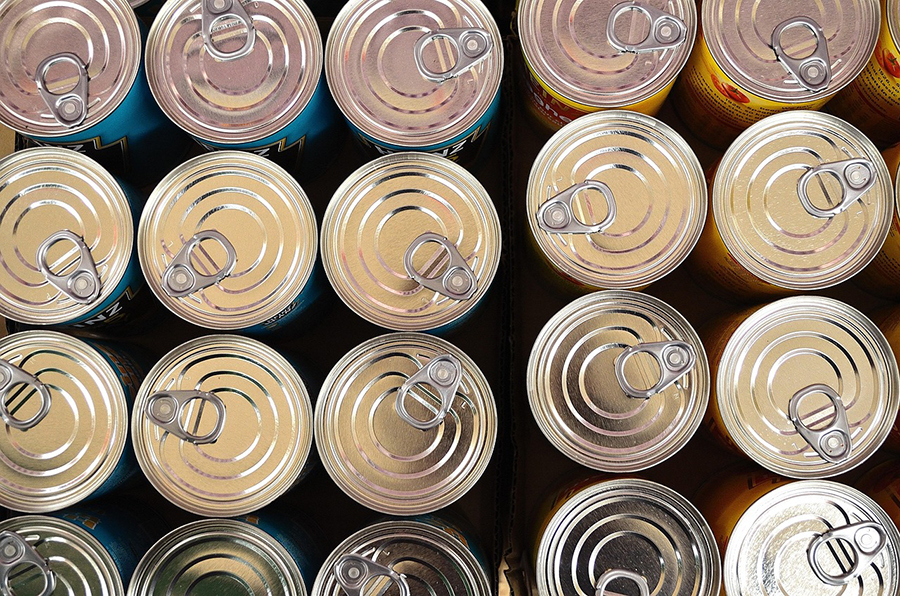
(public domain pictures)
