

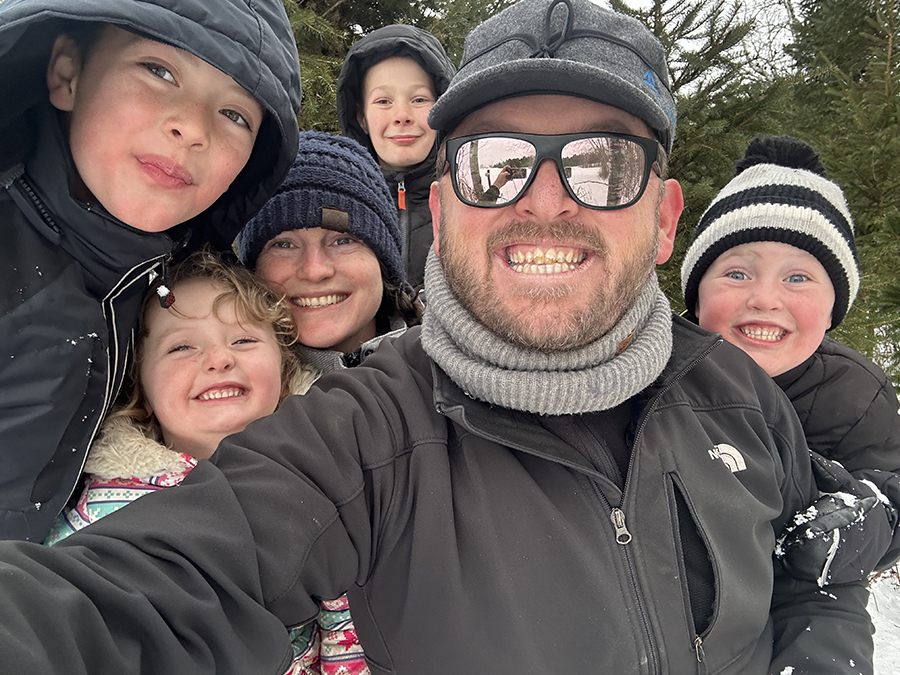
The Hurtubise family (from left) James, Elizabeth, Stephanie, John Paul, Christopher and Thomas, stopped for a selfie while hiking last winter. Director of the Office of Evangelization and Missionary Discipleship, Chris Hurtubise has stopped his screen overuse and hopes others will do the same. (Submitted photo)
Jenny Snarski
Catholic Herald Staff
Writer’s note: This is the first of a two-part series. The first will focus on adult discernment and detachment from smartphone overuse; the second will focus on practical advice directed to parents and educators for guiding children. My family incorporated a digital detox with the beginning of last school year and plans to do so again; it was a great time to make the transition. This year, I plan to utilize Chris Hurtubise’s resource for myself.
In recent years, the Diocese of Superior’s Director for the Office of Evangelization and Missionary Discipleship Chris Hurtubise has perceived “an invitation from the Lord” to examine his daily life “most boldly,” in particular the distractions he finds himself turning to on a regular basis.
“What I hear him saying to me,” he shared with the Catholic Herald, “is: I want to be present to you, but you are too busy, distracted and sometimes even numb to hear my voice.”
During this period, Hurtubise was led to three books that he found “extremely helpful.” First and second were “The Ruthless Elimination of Hurry,” by John Mark Comer and Jonathan Haidt’s “The Anxious Generation.”
Comer’s book allowed him to see “with clarity the ‘rat race’ of hyper busyness that we all pat ourselves on the back for running for what it is: a giant distraction from the good life. [The author] points out that we’ve never been busier, more efficient, more connected — or more miserable. He helped me to understand that like planting a garden bed of onions, we fill our days with lots and lots of seemingly good things, but to allow the things that matter to thrive and grow, we need to thin out most of the onions so the important ones have room to thrive. Unfortunately, we just keep flitting from thing to thing without the space to actually tend to what matters: our vocation, our community, our apostolate and passion projects.”
From that read, Hurtubise was convicted the relationship with his smartphone “needed serious thinning.” Like most people, he used his device for “objectively fine things” like monitoring personal and work email, watching educational videos about his hobbies and passions, keeping up on the news and sports, playing some games, etc. “Nevertheless,” he shared, “when I stepped back and sincerely asked myself, a year from now—five or ten years from now, even on my death bed—what are the things I’ll want to have prioritized?
None of the answers took place on any of the apps on my iPhone.”
Enter the second book, which helped solidify his resolve not only for his own tech use, but as a conscientious parent. Haidt’s book hit on points Hurtubise and his wife Stephanie found “extremely convicting.” The “veritable mountain of data and painful anecdotes” about how digital technology usage is making many valuable things so much harder.
He named the abilities to: deeply focus, deeply be present in prayer and to the people we love, deeply be present to our own interior life, and to get out of our comfort zones physically, socially, emotionally and, among others, take healthy risks.
After all this, in Fall 2025, Hurtubise embarked on a phone fast. He totally shut off his phone and did a digital detox combining it with a ten-day break from work (since much of his workday is spent on his Apple computer—a huge, even more powerful iPhone).
“I can honestly say that it was the freest, most joyful ten days I’ve spent in years,” Hurtubise affirmed and afterwards he got rid of every app “that typically ate away” his time: work email, personal email, the Safari browser app, YouTube, social media and sports apps.
“I rode that high for months, but eventually many of those distractions made their way back… Finally, in prayer one morning, I realized that I needed a boundary that I didn’t control,” Hurtubise admitted.
This led to him asking a trusted friend from his men’s group to password protect his ability to add apps. “Ever since then, I’ve been free and it’s been such a gift.”
Hurtubise encountered the third book in the midst of this personal growth and transformation. “The Tech Exit,” by Clare Morell—who credits Haidt as the basis of much of her work—took the “digital detox” one step further as Morell’s work is an attempt to assist families and, ideally, whole communities in living counter-cultural relationships with digital technology.
Two turning points in Hurtubise’s ministry were the result. Making the youth summer program Extreme Faith Camp (EFC) totally phone-free was one.
“We’ve always encouraged attendees to leave their phones at home,” he reported, but noted they didn’t insist on it very well. “After all of this, it became clear to my team that it was time to insist. After all, the goal of EFC is to lead attendees to a deep encounter with Jesus. And as I mentioned above, our smart phones are a comfort blanket that makes being truly present to ourselves, those around us and Jesus Himself, much more difficult.”
Running the idea past core camp leaders at parishes there was unanimous support for the idea.
“I think that there were definitely some growing pains for folks during camp, but we 100% expected that,” he confirmed. “After all, smart phone addiction is very real. Studies show that digital technology is as addictive as drugs like cocaine, if not moreso! But the overwhelming feedback was that it was an awesome change.”
The other turning point was Hurtubise’s creation of a resource card called “Saints with Smartphones,” which pulls together the best practical advice to date he has discovered.
“Morell inspired me to realize that the Lord isn’t working in me just for my sake. I needed to share it more broadly.
“Saints with Smartphones is not a prescription or something that I would ever tell anyone that they have to do, but if people are dissatisfied with the amount of attachment to their phone and distraction they experience from it, it has proven to be really helpful.”
Truly deciding to “break-up” with your phone is at the heart of experiencing the transformation Hurtubise described, as well as “really giving control of it to the Lord.
“It’s really inconvenient to have a dumbed-down smart phone in our society, so you have to be ready,” he advised.
Hurtubise’s conviction is, as the saying goes, “You are what you eat… When it comes to our hearts, our minds and our character the saying applies just as well. What we watch, read and listen to forms who we are.”
He emphasized, “Being a disciple of Jesus while having a world of entertainment and stimuli in our pockets is a huge challenge. The guide we put together is designed to help us be proactive in putting Christ at the center of our lives in place of our smart phones.”
“How to be Saints with Smartphones” is available at catholicdos.org/evangelization-resources and features seven aspects.
Sanctify the day’s bookends through prayer before picking up the phone in the morning, and ending the day with night prayer rather than scrolling.
Choosing one day for a “weekly digital sabbath” to literally turn the phone off and put it away.
Consecrate tech-free spaces. Refrain from bringing the phone to Mass, keep phones away during meals and create a phone-free prayer space at home.
Transform your phone into a tool by treating is as such, removing entertainment and distracting apps. Delete the browser if needed, check personal emails from a home computer and work emails during work hours. Enlist accountability guardrails. (Apply these practices to your smartwatch and tablets as well.)
Practice presence and slow down by silencing non-essential notifications, leaving the phone behind when possible and carrying it in a bag rather than on your person.
Institute daily micro-fasts during times for work and/or study as well as during moments for focusing on relationships.
Set guidelines for online Catholic content. While there is much great content that can be helpful for the spiritual life, prudent judgment is needed to assess the fruits of what is being consumed.
Hurtubise concluded he is “very careful to clarify is that none of this is a prescription that I in any way want to put on anyone else.
“Rather, it is a conviction that Lord has put on my own heart, and that friends and brothers and sisters in Christ have also found helpful. If it helps you grow in holiness and making a gift of yourself, praised be Jesus Christ!”
