

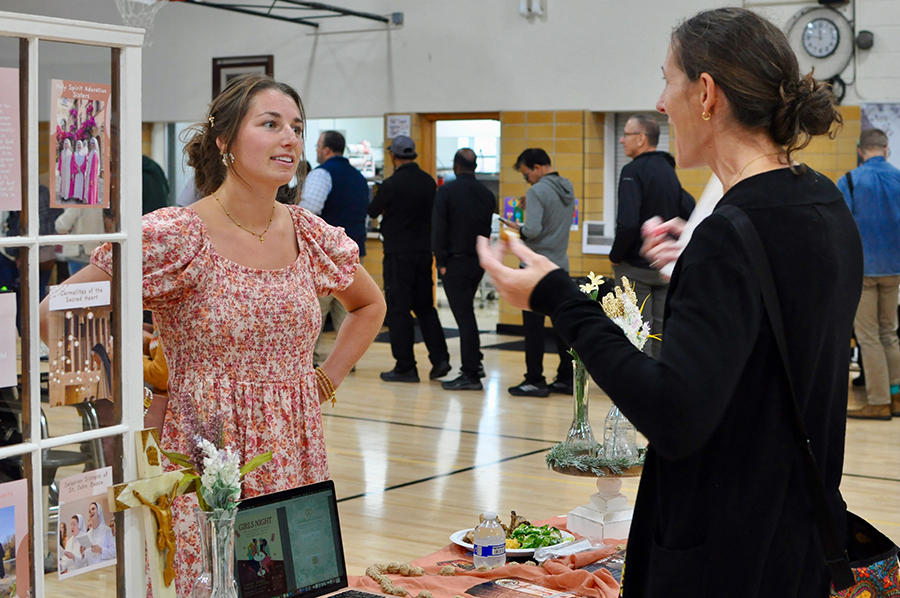
Abigail Beck, left, a former FOCUS missionary who joined the Chancery staff in January and recently married, serves as the Diocese of Superior’s contact for campus ministry and women’s discernment. Here, she chats with a Fall Conference visitor to the a women’s vocations table promoting upcoming Girls Night, chili potluck and Bethany Brunch events. (Catholic Herald photo by Anita Draper)
Anita Draper
Catholic Herald staff
In his first keynote address at the Diocese of Superior’s Oct. 23 Fall Conference in Rice Lake, Theology of the Body Institute presenter Bill Donaghy diagnosed the unfulfillment of humans in a technology-driven world.
Leading off with prayer, Donaghy urged listeners to “cast your phones away, take deep breaths,” and enter into the day.
Kneeling before the altar, he asked for the grace of decluttered minds and uncluttered hearts.
“Lord, let us be children now,” he prayed.
Explaining that his pedagogy includes interacting with images and quotes, Donaghy started with a “Jesus on the Road to Emmaus” painting and shared his background in education.
He has been teaching since the late 1980s, beginning in elementary Catholic school, followed by a boys school, and moving on from there. In his parenting role, “the education never stops,” he quipped, showing photos of his family and joking about the “beautiful mess” of family life.
“What are we made for?” Donaghy pondered. Culturally, we are obsessed with datafication, computing, “stuffing as much information in our brains as possible.”
Our faith says we are not made for datafication, but divinization. “That’s an upgrade, my friends,” he observed.
We are not made for computing; we are made for communion, relationships. “That’s the high country,” he added, “not just having all the answers.”
Quoting Psalm 24, “This is the people who long to see your face,” Donaghy said, “to be human is to long.” Synonyms: Ache, pine, yearn. He quoted Psalm 63: “My soul thirsts for you.”
“We’re gonna talk about AI today, I’m sorry,” he joked.
Donaghy quoted Fr. Thomas Dubay: “We must begin with the beginning: you. As a human being, you are a thirst. Every single choice you make all day long is proof that you seek, you desire, you want, you lack. Nothing is ever enough. We were born that way.”
“We are an embodied ache,” Donaghy added, quoting Pope Leo XIV in Magnifica Humanitas: “So-called artificial intelligences do not undergo experiences, do not possess a body, do not feel joy or pain …” They “do not mature through relationships and do not know from within what love, work, (or) friendship … mean” (99).
“I’m not saying we need to become like Catholic Amish,” Donaghy said, but he showed two photos he’d asked AI to generate: the first one was of a boy playing “in summer mode” in the 1980s, and the second photo was of a boy playing in “summer mode” today.
In the first photo, the boy is wearing a baseball glove, running and smiling. The second boy is sitting on a couch, wearing headphones, staring into a screen, unsmiling.
“Isn’t there a kind of maturation that happens when we engage with the world, not a screen?” Donaghy asked. “Do we have the sense that we are hampered now in our engagement with reality?”
Laying out the plan for the day, Donaghy identified four goals: “Look at cultural tends. Ask how it’s affecting us a educators. Seek the wisdom of the ancients. Offer a fresh path for true education.”
He quoted Pope Leo: “Digital education … is not a bad thing; there are enormous opportunities for study and communication. But, do not let the algorithm write your story! Be the authors yourselves; use technology wisely, but do not let technology use you. … learn to humanize the digital, building it as a space of fraternity and creativity … not a cage where you lock yourselves in, not an addiction or an escape.”
There were four ruptures, or incongruencies, in the Garden of Eden, Donaghy said – a break in a relationship with God, ourselves, each other and nature.
“The past 40 years have seen a shift from play-based childhood to screen-based childhood,” he quoted, from Jon Haidt, “The Anxious Generation.”
“To be human is to play, to taste and see, to run, to climb a tree, feel awkward, sweaty palms, all of it,” Donaghy added. “We need a resuscitation of our culture.”
“Attention is the beginning of devotion,” wrote the poet Mary Oliver. Being human is being attentive to other humans.
A person is a kind of sacrament, Donaghy continued, and in the presence of a sacrament, we should be reverent. The human attention spans today, according to a Wall Street Journal article from 10 years ago, is 8 seconds, compared to 9 seconds for a goldfish.
“Because of our phones, we are forever elsewhere,” said the sociologist Sherry Turkle.
Donaghy looked at some current lingo: World wide web, Internet, cell phone, how many bars do you have.
“You’re a prisoner,” he said.
Quoting Ludwig Feuerbach’s phrase “you are what you eat,” Donaghy observed if digital consumption were expressed in weight, “we’d weigh 7,000 lbs.”
We have more leisure time than humans at any point in history, yet we aren’t very leisurely.
To be a human is to be attentive and present, he pointed out. Pope Leo tells us to “humanize” things – in classrooms, add plants and art, personalize them. “Put a Glade Plug-In in the wall, especially if you teach at an all-boys schools,” he joked.
“Leisure is a form of that stillness that is necessary preparation for accepting reality. Only the person who is still can hear, and whoever is not still, cannot hear,” he quoted Josef Pieper.
“Abide, tarry, linger, be,” Donaghy said. “We stink at this today.”
We are fundamentally changing life, our species, when we outsources our relationships to bots and for-profits. “We are at the brink of having more relationships with tech than with people,” Donaghy quoted, referencing psychology professor Dr. Mitch Prinstein’s work on the dangers of atrophied social skills, loneliness and fake, technology-driven intimacy. We must “reclaim what it means to be human.”
“A wonder-starved culture” is going to come to ask these questions,” he added.
Speaking on Dr. Ian McGilchrist, the psychiatrist, philosopher and neuroscientist who wrote the 2009 book “the Master and his Emissary,” Donaghy identified the left hemisphere of the brain as the place of precision, language and analysis that focuses on parts, sequential thinking, language and grammar, logic and calculation, labels emotion and seeks fact.
The right hemisphere, meanwhile, guides meaning, relationship and attention, sees the whole and is associated with pattern recognition, story and metaphor, emotional tone, presence and intuition and recognizing faces.
Tech use is “wiping out our right hemisphere,” he said. “The mere datafication of the world leads to isolation and desperation. We lose sight of our story. We lose sight of our call … to a communion of persons.”
He offered a quote from a Cornell University math professor: “If the AI can do math better than any human being, what’s the point?”
He showed clips from the news program 60 minutes and the New York Times, both on seeking to understand the role of humanity in a world with artificial intelligence. In these secular news outlets, where faith has traditionally been ignored, if not mocked, people were talking about God and the Bible.
“We’re on the edge of something beautiful,” Donaghy concluded. “Can you feel it?”
