

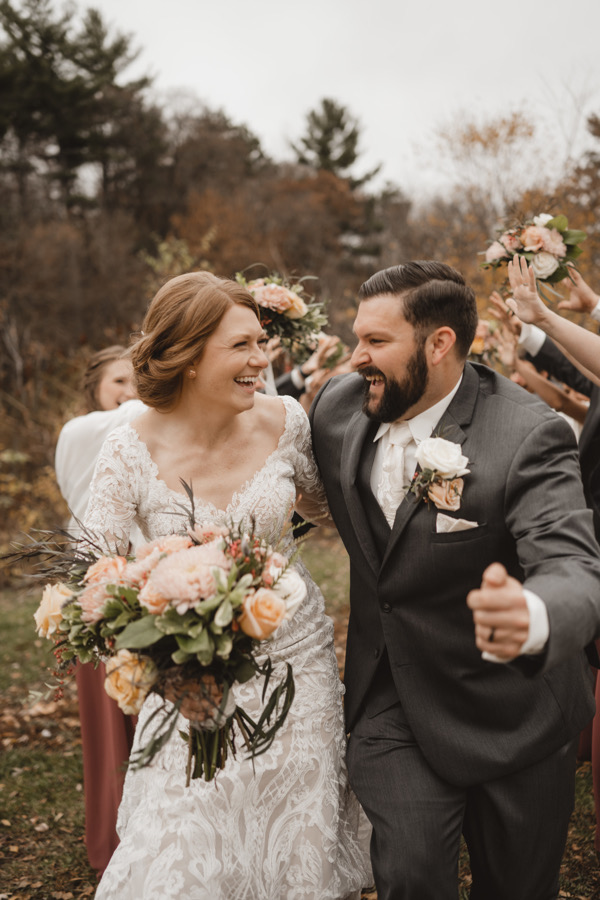
Clare and Tyler Kircher, who met on CatholicMatch.com, were married in 2022. (Submitted photo)
Earlier this year, the Catholic Herald’s editor, Anita Draper, approached me about writing a story on Catholic singles in the Diocese of Superior.
She was aware of some diocesan adults who’d joined the dating website CatholicMatch.com to possibly meet their future spouse online, given our rural setting here in northwestern Wisconsin. I also knew couples who had met their match through diocesan youth events or others while attending a Catholic college (outside the diocese, but some moved back after marrying).
Two gracious couples answered four questions I posed. The diocese’s Associate Director of Youth Discipleship, Tyler Kircher, met his wife, Clare, on CatholicMatch. They have two children, one son and one newborn daughter. Kevin and Jessi Johnson, now parents of four children, met at a High School Discipleship weekend while they were in high school.
As I reflected on the answers they all shared, I was struck by how my husband’s and my story fits in nicely with the perspective of God’s providence. He was prompted to sign up for a profile from an advertisement he saw in the Superior Catholic Herald in the summer of 2009. I’ll let my husband, Denny, share in his own words:
“Feeling drained and confused after a failed engagement (to a non-Catholic widow with adolescent children), I felt called to try and reconcile those events with the possibility that God might have been preparing me for something greater than I was capable of seeing at that point of my life.”
For an engineer whose livelihood is judged by efficiency and productivity, it wasn’t easy to accept that everything he’d put into that relationship wasn’t a waste.
“I felt so foolish about it,” he recalls, “but my reconciling turned into seeking a deeper relationship with God and a call to reconnect with the faith of my Catholic upbringing. Little did I know at the time that sharing this story on my CatholicMatch profile touched my future wife’s heart in precisely the way she needed to reach out in trust to me.”
The first question I posed to both couples was about the disposition towards dating before meeting their spouses.
Tyler responded for himself and Clare: “Definitely hopeful first and foremost.” After “traditional dating” from high school through college, he admitted some anxiety moving into his early 30s, having not yet found “the one.” Although being open to online dating came later, he found it a helpful tool.
Thoughtfully putting yourself out there in a profile is vulnerable, but as he discerned his vocation with greater clarity, Tyler said he “absolutely grew more in a trust of God’s will.”
Kevin had just left a relationship that ended because of religious difference. While Jessi described her teenage self as “immature, just wanting a boyfriend” and not conscientiously Catholic at the time, she does recall having a “strong desire to marry a Catholic man someday.”
For her, “meeting Kevin and Jesus in the Eucharist” helped to shift her disposition from dating for dating’s sake towards one of dating “to find your spouse.” Kevin credited God’s mercy and will for the opportunity to meet Jessi at such a young age, which allowed them to grow in their faith together.
Denny and I were both in our mid-30s when we met, both a little worse for the wear from previous dating experiences. As I have shared in the past, I felt called to give my entire life to Christ from a young age, but it wasn’t until I was living in a community of consecrated women that I more maturely discerned God’s call. The experiences I had over those years of formation, prayer, spiritual guidance and intense sacramental life firmed up the foundation I needed to build a holy relationship.
I had entrusted my future spouse to Our Lady, and more than once over a number of years—especially after becoming a single mom—thought she must not have heard my prayer, or that I hadn’t prayed it in the right words or from a good enough heart.
Denny had been blessed to witness great marriages built on the bedrock of the Catholic faith in his childhood parish of Our Lady of Lourdes in Dobie. He shared, “I knew that at that point, I was convinced that I did not want to consider starting a new relationship with a woman who didn’t deeply treasure her Catholic faith.”
The second question was how important it was to find someone who valued the rural lifestyle. I also asked, “What challenges and opportunities does living in the small towns in or near the Diocese of Superior provide for dating, marriage and family life?”
It was “very important” for the Kirchers. They “definitely wanted to be on the same page” for where they wanted to raise a family, and it was an early conversation for them.
Tyler recognized the benefits of a parish community where young families can “come together to worship the Lord” as exactly what they wanted. They value living in a rural setting for what it offers, “in terms of just living space — grass, trees, and the opportunity for some self-sufficiency with hopes of a small hobby farm.”
Living rurally gives them the chance to give their children a lifestyle that he and Clare both had in their youth.
Jessi grew up on 40 acres in Cable, “with the ability to hunt, ride four-wheelers, and just be away from the world in a sense. For me, that’s all I ever wanted was to live in a rural place and raise a family. Kevin and I are very blessed to have found each other so young and didn’t have to go through the hardship of finding someone to date in a rural area.”
The Johnsons are grateful for “a wonderful homeschooling co-op of Catholic families that spans from the Lake Superior all the way to Hayward.” She said they love living rural when it comes to planning date nights: “It could be as simple as fishing, hiking, rock-picking on the shores of Lake Superior, or finding local places to eat out, go bowling, and things along those lines.” Their daily life is rural, but they are willing to drive occasionally for bigger city amenities.
Growing up in a town about the size of Rice Lake in Northern (Lower Peninsula) Michigan, and then having traveled and lived in other countries, moving to a small town was definitely not what I sought. But when I saw Denny’s profile picture—chainsaw in hand by a pile of firewood—I thought of the good memories I had out in the woods with my dad and siblings. “Nothin’ like Northern living” were the first words I wrote to him.
Like the Johnsons, I value immensely the opportunities to expose our children to elements of city life. It’s a given in my family because they’re all out of state, some even out of the country, and experiencing the world on a global scale is humanly—even religiously—enriching. But as my family has heard me say countless times, “You couldn’t pay me to raise my kids in the city.”
For us as parents of four children, now ages 11-22, the pace of life, access to natural beauty and wild-wandering is irreplaceable. The sense of community and getting along with different types of people in a small town is, in my personal experience, much easier than in a suburban setting.
My third question was about the support found in local parishes for marriage preparation and newlywed couples.
Denny and I were married in Michigan, where we did have access to some helpful resources. Although we were first living in Webster where Denny works, because I had a son who would be attending St. Francis School, we immediately connected with other families in Spooner. We have found good marriage enrichment resources online.
The Kirchners were married in the Diocese of La Crosse and feel they had an excellent preparation for marriage.
For the Johnsons, their engagement coincided with the COVID-19 pandemic, when even access to the Eucharist was very limited. They would have preferred more in-person interaction preparing for marriage and struggled to feel supported as a young couple, but they feel they have landed where God led them.
One of the dynamics we have valued in our small-town setting is building friendships and mentoring relationships multi-generationally and inter-religiously. We have been blessed by building “found family” with older couples who need yardwork done, who offer music lessons and via connections we have made through the sport of cross-country skiing.
Finally, I asked which words of wisdom could be offered to single adults in the Diocese of Superior who are hoping to meet their future spouse.
Kevin Johnson commented. “The call to a vocation is a whole lot bigger than the desire to live in a certain area. Of course it’s an important decision,” he said. “So, make that desire known to God, but we also have to follow the example our Lord gives us in the Garden of Gethsemane when he first makes his intention known to his Father … ‘Let not my will, but thine be done.’ It’s the same with us.”
He said that trusting in God’s goodness, we need to consistently allow our desires to be purified, be willing to make sacrifices, but mostly “to radically place our trust in God and his will for our future.”
Jessi acknowledged the value of diocesan youth events and the strong friendships formed among young men and women, whether they lead to dating or not: “It is an opportunity for many young, holy Catholics to form lifelong relationships.”
The Kirchers also encouraged unceasing prayer for your vocation and future spouse. “Thank the Lord for the ways he will answer your prayers, no matter how that looks and for how he will show you the way,” Tyler said, emphasizing that God will answer.
He shared a Scripture verse he prayed during that “seeking” stage and still prays. Psalm 37 (4-5) invites, “Take delight in the Lord and he will give you the desires of your heart. Trust in him and he will act.” He commented that discernment does involve our reason, experiences, desires and community. “Know that the Lord is at work all over the Diocese of Superior and he can answer that prayer in so many ways,” he said and recommended seeking out retreats individually or as a couple, including diocesan men’s and women’s retreats in January and February.
I can only add that God, in his loving will, will provide for us. I resisted signing up for Catholic Match for quite some time. It was only after trying things my way, certain that I knew best, that a priest-friend challenged my thinking with a question that holds just as true today as it did when I felt desperate to see God’s plan unfold:
“Who are you to tell God how and where he can act?”
