

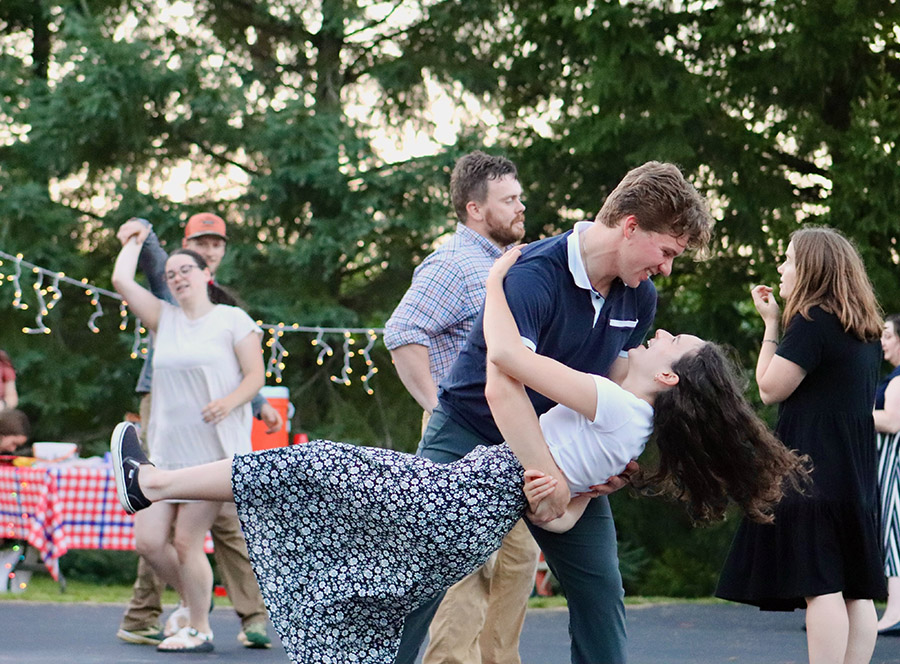
Mitchell and Mackenzie Klatt dance at the Summer Swing event outside Our Lady of Lourdes in Dobie. (Photos by Aidan Jones)
As the summer neared its end, 30 young adults gathered in the parking lot across from Our Lady of Lourdes Catholic Church in Dobie for an evening of dancing and fellowship. Organized by an unofficial Diocese of Superior young adult group, this inaugural Summer Swing event was open to dancers of all abilities from across the diocese and beyond. Although held in a simple parking lot in the open air, an ambience of festivity was encouraged by strings of twinkling lights, a snack table and a guest book. The event ran from 6-9 p.m. on Aug. 9, wrapping up with attendees praying night prayer in the nearby church.
In recent years, swing dancing has experienced a revival in many Catholic young adult circles. Although Catholic colleges such as Christendom and Benedictine feature active swing dancing clubs, the revival also reaches beyond the confines of Catholic schools. Speaking personally, I was introduced to swing dancing in college despite never attending a Catholic school, eventually becoming a regular attendee of weekly dances organized by students from University of Minnesota Duluth’s Newman Center.
However, helping organize the local Summer Swing event led me to reflect on this dance revival. What is driving it? Why are young people turning (enthusiastically) toward an art form that their grandparents (or great-grandparents) grew up with? After giving the matter some thought, it seems that this burgeoning movement is driven by a desire for authentic culture, social connection and innocent fun.
As a dance style, swing is reasonably simple to learn, with a foundation of movements that can be built upon as the dancer grows in confidence. It combines predictability with creativity, requiring dancers to communicate and trust each other in order to execute various moves. As an art form, dance is intimately linked to culture, and it is no coincidence that the styles of dance that became popular in the wake of the sexual revolution reflected the cultural shifts of the 1960s.
Perhaps in some ways, the revival of swing dancing can be seen as a rebellion against the formless, individualized, and hypersexualized styles of dance prevalent in our post-Christian culture.
“I think it’s so good for our generation to continue to learn how to formally dance,” Rachel Schmidt, an attendee of the Summer Swing event, commented. “Whether that is swing, circle dances, or other partner dances… I think it creates a really pure, beautiful setting to move the way God intended for us to move while enjoying his gift of music.” In a small way, the swing revival represents a countercultural pursuit of the good and beautiful in an artform that has largely been corrupted by modern culture.
However, there is also a more practical reason for the prevalence of swing dancing in young Catholic circles: dances are a great way to meet other young Catholics. “I like the social aspect of swing dances,” Summer Swing attendee Matthew Halberg explained. “They’re always a good place to have fun and good conversations all at once.” A swing dance can serve as a hub for making new friends in a world where young Catholics are in the minority.
There’s also a romantic element to dancing. “I learned to swing dance from my husband, Ben,” Rachel Schmidt reflected. “He actually took me swing dancing on our first date and we learned other moves together from there on.” In a society that often lacks clear courtship rituals, swing dancing provides a “script” that guides the interaction between the sexes. A man asks a specific woman to dance, and she either accepts or declines. While dancing, the couple is able to carry on a casual conversation, offering an easy opportunity to get to know someone of the opposite sex. To dance several consecutive dances with the same partner is usually considered impolite (unless they are an established couple), and so the dance either ends with a continuation of the conversation, or a friendly “thanks for the dance.”
Convention instructs that if a man drops his partner while performing a complicated dance move, he is obliged to give her chocolate. If he drops her a second time, flowers are required. For a third offense, it is (jokingly) presumed that he owes her a date.
It should be noted that these customs can vary slightly depending on the community, and that swing dancing etiquette is largely intuited rather than stated outright. However, the conventions of the artform provide a helpful framework within which men and women can learn to interact in a healthy way. Noting the way that swing dancing offers a unique opportunity to experience the complementarity of the sexes, Schmidt commented that “as the woman, it forces me to put complete trust in my partner because he is deciding the next moves and steps. I really love that it creates that bond.” However, Schmidt admitted that this trust was something that took time and practice to develop. “It was very difficult for me at first, and I really had to learn to just trust my dance partner.” Over time, dancing can create a complementary relationship, as the couple learns to intuit the other’s movements. Through all of this, swing dancing helps to cultivate community and relationships by encouraging respectful interactions between young men and women.
However, in addition to the abstract reasons for the recent revival, swing dancing is simply fun. Speaking from my own experience, it is remarkably satisfying to learn a new move and practice until you can execute it flawlessly, to move gracefully in tandem with a partner, and to synchronize your movement with the music. Schmidt pointed out that in addition to the unique partnership that dancing forms, “it’s just so fun to move your feet in a unique way!” Halberg similarly emphasized the fun of dancing, noting that “I came to the (Summer Swing) dance to see friends and meet new people, and I had a ton of fun dancing and doing just that.”
For those who have never learned to swing dance, Schmidt and Halberg had words of encouragement, with Schmidt particularly emphasizing that it’s alright to ask for help. “Some of the most fun moves that (my husband and I) know and use were taught to us because we asked others at different swing events,” she commented. Halberg also pointed out that “it’s not super difficult to learn, so whether you want to do simple moves or try to get more advanced with it, you can find a level that you enjoy.” He also encouraged young adults to attend events hosted by the diocesan young adult group. “Going to young adult events can be intimidating, especially if you don’t know who will be there,” he admitted. “But I’ve found that it’s always worth it to go and make meaningful friendships!”
Through the success of the Summer Swing event, it’s clear that the burgeoning swing dance revival is alive and well in the Diocese of Superior. By embracing swing dancing, young Catholics within our diocese have found an opportunity to restore culture, form lasting relationships, and have fun together. God willing, future swing events will continue to facilitate just that!
Young adults (ages 18-29) who are interested in attending future swing dance events or in being involved with the Diocese of Superior’s young adult group are invited to contact JulieAnne Johnson at .

Aidan Jones
