

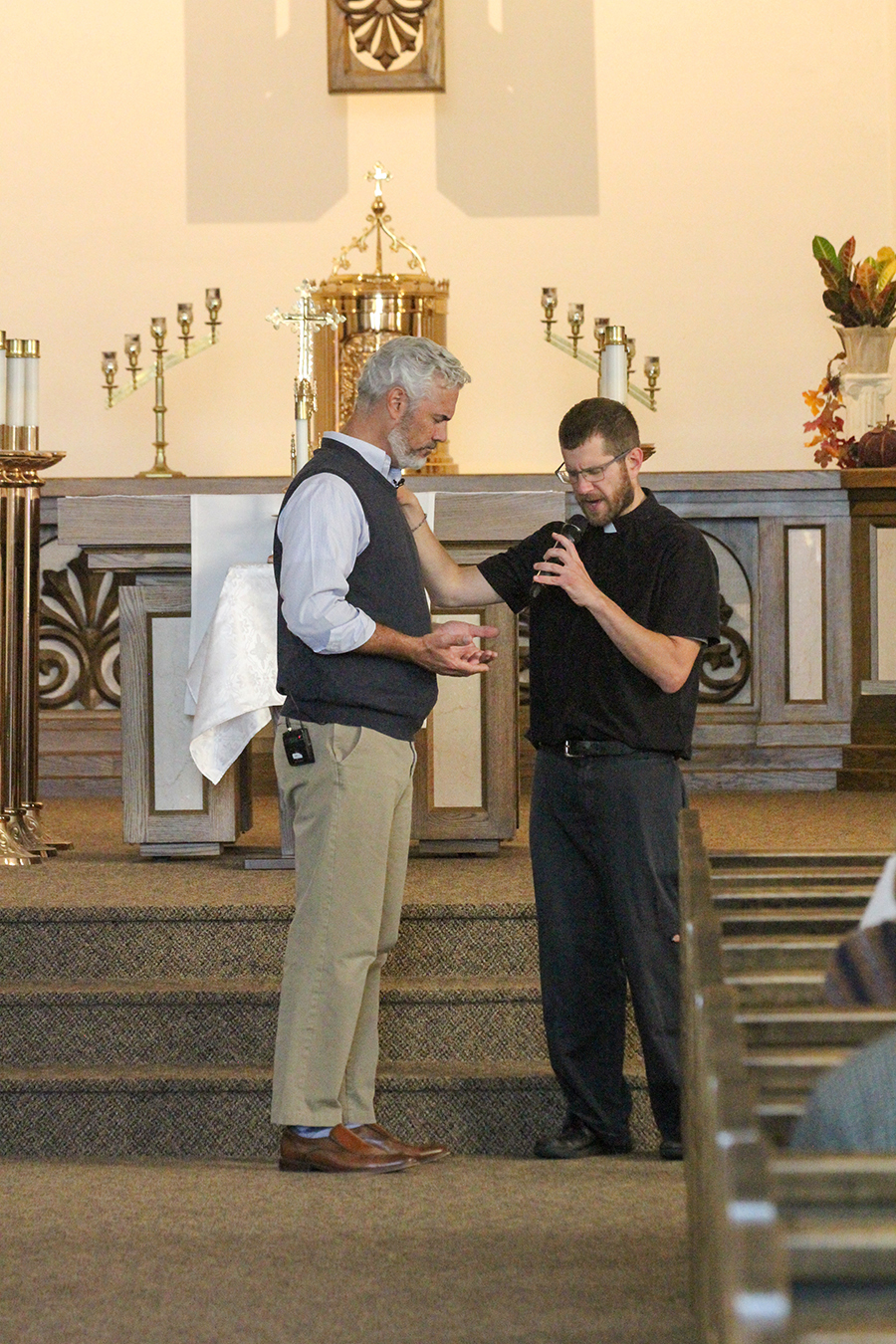
Fr. Adam Laski prays over Bill Donaghy of the TOB Institute before the first of three keynotes for the Fall Conference theme, “Wonderfully Made: Rediscovering the Gift of Being Human.” (Photo credit: Mindy Hamilton)
Jenny Snarski
Catholic Herald Staff
Asking “What are we made for?” and revisiting the human desire for communion, Theology of the Body Institute presenter Bill Donaghy’s afternoon keynotes at Fall Conference on Oct. 23 continued the theme of choosing “analog versus algorithm” experiences.
The foundation for the second keynote was a summary of St. Pope John Paul II’s Theology of the Body teachings. Donaghy offered three keynotes during the Diocese of Superior’s annual educators’ conference in Rice Lake; this article covers the second and third.
With “very brief brush strokes,” Donaghy introduced Catholic anthropology—the holistic study of humanity—and the philosophy of phenomenology with a focus on human first-person and conscious experience. He observed how “wonder-starved” people are today.
Incarnational truth
Donaghy began his second theme, “Human Love (and Life) in the Divine Plan,” touching on the issue of “digital obsession” and how at odds it is with “the incarnational truth of who we are.”
He presented a series of slides with quotes from an AI-generated “conversation” a friend of his started on “How might artificial intelligence help and possibly hurt humanity?”
“That’s a thoughtful question,” the chatbot responded. “Humans are relational creatures. AI can imitate remarkably well.”
Engaging with the audience, who nodded and gasped, Donaghy read through the content ChatGPT had provided: “That creates a temptation to substitute simulated companionship for real communion. Christianity is fundamentally incarnational.”
The chatbot continued recognizing that AI cannot replace friendship, marriage, parish life, spiritual direction, confession, the Eucharist.
“If people begin preferring artificial relationships because they are easier, something profoundly human is lost,” the chatbot replied. “Intelligence and wisdom are different things. I can explain humility. I cannot be humble. I can describe forgiveness. I cannot forgive. I can analyze the Beatitudes. I cannot become holy. Christianity ultimately aims not at acquiring information but at transforming persons.”
The final sentences were, “The danger isn’t that AI teaches falsehood. It’s that it leaves no room for stillness.”
Donaghy described the circumstances of his first encounter with Pope John Paul II’s teachings. He was 16 and his parents had recently divorced when he came across a book called “Original Unity of Man and Woman.”
“If you know the man, the vision becomes more potent,” he said and proceeded to give biographical snapshots of Karol Wojtyla from infancy through young adulthood. Donaghy highlighted how, as an actor, poet and playwright, the young Wojtyla was part of a rebellion and resistance within Nazi-occupied Poland that began World War II.
Ordained in 1946, after the war ended, but with Poland under Communist rule, Fr. Wojtyla would form and mentor young couples on camping trips in nature, creating an environment with them based on human connection, “a priest of God camping among the people resisting the tyranny” that was trying to wipe out their faith.
Donaghy had a multitude of photos of John Paul II in those years—relaxed, not wearing a collar, celebrating Mass “on an overturned canoe.”
After moving through his ordination as bishop, appointment as a cardinal and participation in Vatican II, Donaghy described the “tender fatherly authority” John Paul II exuded after his 1978 election to the papacy. “He was now the leader of the rebel alliance,” which centered around an understanding of the human person and human love that was grounded in the mystery of God’s creation and salvation of mankind.
He summarized Theology of the Body—the 126 Wednesday audience teachings given over five years—in three points: First, an education in being human; second, a key to the great mystery of God; third, a biblical meditation on the holy communion of God, sexuality and life.
As a “precise definition,” Donaghy quoted Fr. Thomas Loya: “The great mystery of how the invisible is made visible through the physical.” He then related this to the definition of sacrament in the “Catechism of the Catholic Church,” in paragraph 114: “as a being at once body and spirit, man expresses and perceives spiritual realities through physical signs and symbols.”
“We are by our nature the poetry of God,” Donaghy stated, explaining that the ancient Greek poema literally means “something created, crafted.” God is, therefore, not only an artist but the greatest poet.
Reflecting on the Incarnation and incarnational nature of the human person, body and soul, Donaghy commented on the “ew factor” characteristic of the modern disembodied culture that feels repulsion to humanness more than a sense of awe and wonder. He related this to the Scriptural account of Jesus’ teaching about the Eucharist—his command to eat his body, drink his blood—in the Gospel of John, chapter 6.
The Theology of the Body, Donaghy explained, is deeply a spousal mystery: It’s an encounter with reality. “The plan of God for us is so intimate, tender and beautiful … it’s too much … a communion of persons, mission of the family,” he said, emphasizing “encounter,” “communion” and “mission.”
Quoting Pope Francis, he added, “The dynamics of the relationship between God, man and woman, and their children… are the golden key to understand the world and history, with all that they contain. Finally, they understand something… the love of God himself.”
Donaghy concluded, “We don’t make marriage up. Marriage came down because it’s part of God’s own identity.”
Creating wonder
The final presentation returned to “Creating a Climate of Wonder” as the antidote to the de-humanization of our overuse of digital technology and the rapid advancement of AI.
The iPhone, Donaghy stated, “is one of the biggest obstacles to becoming a saint.” It is an infinite distributor of distraction and entertainment.
He shared three quotes. One, a Buddhist proverb describing that we become what we behold: “By drinking a cup of tea, I stop the war.” The other quote, of G. K. Chesterton, “The saint… will generally be found restoring the world to sanity by exaggerating whatever the world neglects… Each generation is converted by the saint who contradicts it most.”
“Wonder is needed so that beauty might enter into human life, society and the nation. We need to marvel at everything that is found in man.” This quote was from Cardinal Wojtyla in September 1978, the month before he was elected pope.
“Wonder is his weapon of resistance,” Donaghy affirmed.
We have to exaggerate the slow in a world that moves so fast, Donaghy challenged. Giving the example of how hard it might be to think about sitting for 30 whole minutes doing nothing productive, he asked, “What difference is that going to make?”
“Try it for a week and you’ll see how refreshed and rejuvenated you’ll be,” he encouraged, affirming that wasting time is often the most fruitful endeavor.
Donaghy talked about what he called “MMS, Martha, Martha Syndrome” and used a slide of a painting of Mary and Mary seated with Jesus to expound. He also quoted Pope Benedict XIV on the dynamism of desire, the path of ascent. “We are pilgrims heading for the heavenly homeland … not suffocating the longing that dwells in the heart of man, but about freeing it, so that it can reach its true height.”
“Our identity flows from our receptivity,” Donaghy said. Being rooted in your identity is what should direct your activity. He suggested writing down a list of things that “fill the treasure chest” and build up a “climate of wonder” and feeds the spirit.
He differentiated inculcation from education, the latter inviting the student into curiosity and drawing up towards mystery and awe. “We don’t want to be lectured. We long to be lured.”
Donaghy drew his presentation to a close, returning to a concept introduced in the second keynote—the Polish word srodowisko—which translates as environment, describing the warmth of gathering around a hearth-place.
“How we can make something we do, where we live more relaxed, warm, not just focused on production … Wherever you abide, do your best to make it human – then watch how productivity soars and morale is boosted,” he challenged.
In the context of catechesis and education, this keeps in mind teaching “the whole person,” inviting them into intimacy with Jesus, not mere knowledge of him. The “secret sauce” of the New Evangelization is keeping “incarnation” as priority over “information.”
“An embodied encounter is an invitation into communion and a call to mission,” he concluded.
