

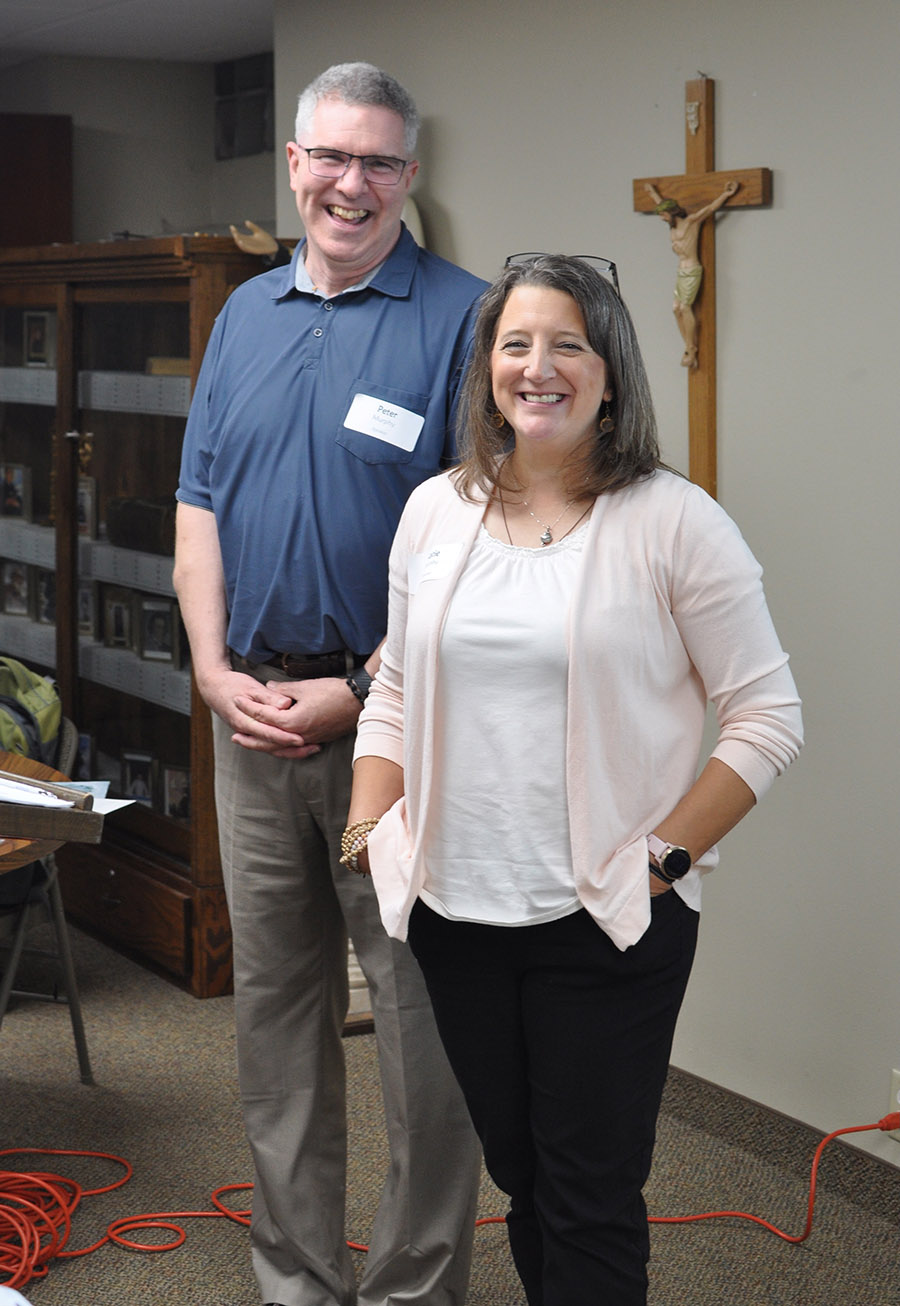
Dr. Peter and Katie Murphy live in Little Suamico, in Oconto County, where he serves as the associate director for the Curia for the Diocese of Green Bay. Katie homeschools their children. (Catholic Herald photo by Anita Draper)
Anita Draper
Catholic Herald staff
Sharing wisdom applicable to anyone raising children, Dr. Peter and Katie Murphy spoke on peaceful parenting Sept. 27 at the Diocese of Superior’s Homeschool Conference.
Loree Nauertz, the associate director of the Office of Evangelization and Missionary Discipleship, whose focus is on marriage and family outreach, welcomed about 40 adults to St. Joseph Catholic Church in Rice Lake.
“I know what some of your houses look like this morning,” she joked, adding that God is what makes a mess beautiful.
“Raising a young family is challenging,” she admitted. “I shed many a tear when I was in your place.”
The purpose of the conference is to bring everyone together to network, talk and build relationships, she said. The emphasis is not on curricula or academics; it could be more accurately described as a retreat for homeschooling parents, who can sometimes feel isolated.
Chris Hurtubise, director of Evangelization and Missionary Discipleship, described educating one’s own children as “such a beautiful way that we can allow the Lord to provide for us.”
Hurtubise, who together with his wife homeschools their children, said he hopes parents will leave confident, with some tactics and faith that God “will provide for the needs in our life.”
Bishop James P. Powers then opened the conference with a prayer asking for God’s help to put aside the noise and busyness of the day.
A peaceful presence
Dr. Peter and Katie Murphy, the day’s keynote speakers, have homeschooled their six children for 17 years. They were in Washington, D.C. when Peter worked for the U.S. Conference of Catholic Bishops; the family couldn’t afford private school there, so when they moved to the Diocese of Green Bay for a job change, they enrolled their children in a classical school.
Every homeschooling family has a different approach based on what works for the family.
“We’re all different; we’re all unique,” she affirmed. “We homeschool because of our family culture.” When her kids went to school and she saw their relationships changing in a negative way, she brought them back home.
Peter asked attendees to introduce themselves and talk about their family, and then answer a question: “What’s your why?”
Responses ranged from positive childhood homeschooling experiences to stabilizing education for frequently moving military families to supporting children who were not ready for school or not thriving in traditional classroom settings.
The importance of fostering a strong family culture was often cited, and for all the homeschooling parents, the decision was practical as well as spiritual.
As one dad put it, they wanted their children’s education “geared toward a saintly life rather than a secular life.”
The Murphys’ biological children have dyslexia and dysgraphia, and their adopted children have trauma, and Katie explained that parents need to be grounded in internal peace – she cited Fr. Jacques Phillipe’s book, “Searching for and Maintaining Peace” – “so that we create that environment that we can raise saints.”
“What we’re really talking about is evangelizing our families,” Katie said. “You as homeschooling families aren’t passing the buck to someone else … I am fully embracing my role as the primary educator … of my family.”
“You have to ground yourself in interior peace,” she added.
Peter emphasized that parents need to let go of their own desired outcomes – for children who are priests or Ivy Leaguers or whatever – and commit to praying and letting God’s will be done.
“If we want to find peace, we have to make sure God is primary in our faith journey and in our family life,” Katie said.
The Murphys pray as a family before bedtime, and Peter and Katie pray when they walk together with the dog every morning, something they can do now that their children are older.
Find a way to get personal prayer time, she advised. “That will help the rest of your day go better. God is a reservoir of grace and peace, and he wants to give you peace throughout your day.”
Peter asked parents to write down what makes them lose their peace with their children, and then to take those situations to God in prayer.
“We want to teach and lead from a disposition of peace,” he said. “If we are not in peace… we don’t have that to give to our children.”
The Murphys met in a counseling master’s degree program, where they were taught that counselors must be a non-anxious, peaceful presence. To maintain that peace, Katie encourages parents to step back from stressful situations and take a few quiet minutes before responding.
“Always be honest with your kids,” she said. Apologize for messing up and admit to mistakes.
“When you do that as the parent in homeschooling, you are modeling for them,” she said. But, she added, “There’s a difference between having bad days and … not having peace about homeschooling.”
She advised parents “going through weeks and months” with a lack of peace to take that to God and discern whether a child should be homeschooled or whether something should change.
Back to Jacques Phillipe’s book, Katie said interior peace means total trust in the Lord. She led attendees in the Litany of Trust, a prayer written by the New York-based Sisters of Life, and when the children returned from their morning childcare in preparation for Mass, she asked parents to pray over them.
Mass
Acknowledging the Feast of St. Vincent de Paul, the “peasant priest” born of privilege who underwent a conversion and dedicated his life to caring for the sick, elderly, slaves and impoverished, Bishop Powers welcomed homeschooling families.
Drawing from the first reading from St. Paul’s first Letter to the Corinthians, the bishop spoke on St. Paul’s reminder to Christians to reflect on the grace they’ve received.
“It’s not something they’ve done anything to deserve, but it’s a free gift from our God,” Bishop Powers said. St. Paul reminds them they now belong to God’s family, and he challenges them to reflect on how there’s no higher status; any boasting should be about spiritual blessings.
“How easy it is to put those worldly desires ahead of what we know should be No. 1 in our lives, that love of God, that love of neighbor,” he said. “The very gift of our lives is a gift from God.”
Our gifts – education, faith, material things – aren’t given to us simply for ourselves.
“Our God calls us to share who and what we are and what we have with others,” he said.
Compassion is so much a part of who Jesus was and what he did, and he didn’t just send his disciples out one day, the bishop said. Over time, he educated them, taught them how to minister.
“How often do we hear in Scripture that Jesus goes off in prayer,” he continued, noting the importance “of allowing those gifts that God offers us to take root in us, to transform our hearts, minds, and to truly put him No. 1 and spend time in his presence.”
In the Gospel from Matthew 9:36, Jesus feels compassion for the crowd and sees they are like sheep without shepherds.
The people of his day understood the importance of a good shepherd so much more than we do, Bishop Powers said. “Our Lord calls each and every one of us … to come to him as disciple, to be sent forth.”
Addressing parents, “shepherding your flock, if you will,” he commented on the importance of parenting with compassion. As homeschoolers, he acknowledged their emphasis on teaching the children, giving that gift of faith, the gift of your knowledge, preparing them for the work.
“It’s not an easy task, I’m guessing not at times a totally fun task,” he said, adding that he was guessing is it also sometimes “an exciting task.”
Jesus sees the sheep without shepherds as lost, but also sees the bountiful harvest given to share with the world. Too often we think “it has to be some huge thing, but a smile to someone on the right day can be worth a million dollars.”
The bishop said he was chuckling about parents saying their children fight sometimes – he thinks Jesus and his disciples probably did as well – but they all loved one another.
“Today, our Lord continues to call us, continues to send us, but he doesn’t send us empty-handed, he doesn’t send us empty-hearted…. Showering us with those gifts, that love, that knowledge, so many ways to share that love with others.”
Our prayer should be, “Lord, how can I be that person you created me to be?” the bishop advised, “so we can be giving of ourselves to others as freely as the Lord, our God, gave himself to us.”
“That dang snake”
Katie opened the second keynote by urging parents to get in the habit of praying over their kids and taking them to daily Mass.
“That dang snake” is a phrase taken from a Dec. 2, 2019, “Abiding Together” podcast. The exorcist priest who was interviewed, Fr. Justin Brady, affirmed that everything the Catholic Church says about the devil is true – especially how he lies to draw people away from God.
Discussing parents’ roles, the couple affirmed that men and women have different challenges.
Katie, for example, is prone to comparison and can become dissatisfied if she feels someone else is doing something better.
Family-of-origin issues sometimes emerge for Peter, who feels out of control when the chaos of family life kicks in.
Fathers, as leaders of their household, have a specific role, he observed. He was looking at the crucifix and realized this is how men win for their family – it doesn’t make sense, but being that sacrifice is the challenge for fathers.
“If we’re not being led by God the Father,” he said, men shouldn’t be leading others.
Citing a quote from St. Francis de Sales, “’The devil does his utmost to banish peace from one’s heart, because he knows that God abides in peace and it is in peace that he accomplishes great things,’” the couple focused on how to abolish the devil, beginning with cultivating a peaceful presence, starting the day with prayer and celebrating feast days.
Homeschooling parents may feel pressure to do all things, but that is not possible, they said. Using the metaphor of a farmer thinning crops in the field, the Murphys talked about thinning schedules and curricula to help their children grow.
“Fighting for our family” and “protecting our schedule,” sometimes involved saying no, Peter said. When their children excelled at soccer and swimming and wanted to join teams that would have required a great deal of travel, the couple considered the impact on their family life and declined.
“Satan is always working to get us,” Katie affirmed. Distraction, dissatisfaction, comparison and “lies we believe about ourselves” are all his tools.
“The family is under attack. Marriages are under attack. And the faithful, we’re under attack. And we don’t always recognize it,” she added.
Staying in the present moment, staying focused on God, maintaining joy and not getting drawn into comparisons with others are all means of fighting Satan’s lies.
“We need to be actively combatting them all the time,” Katie said.
She asked attendees to speak a lie they hear from the devil, and then ask God for the truth to rebuke the lie.
Lies are seeds. If we rebuke them, they die, Peter explains. But if we feed them, they develop and grow and take over our lives.
“The Lord is always speaking to us,” Katie added.
Their suggestions for practical ways of drowning out the lies include praying the Angelus; reading Scripture, staying off social media; practicing gratitude; finding one’s own charisms; and living authentically and seeking community.
The couple stayed for a question-and-answer period following their talk.
