

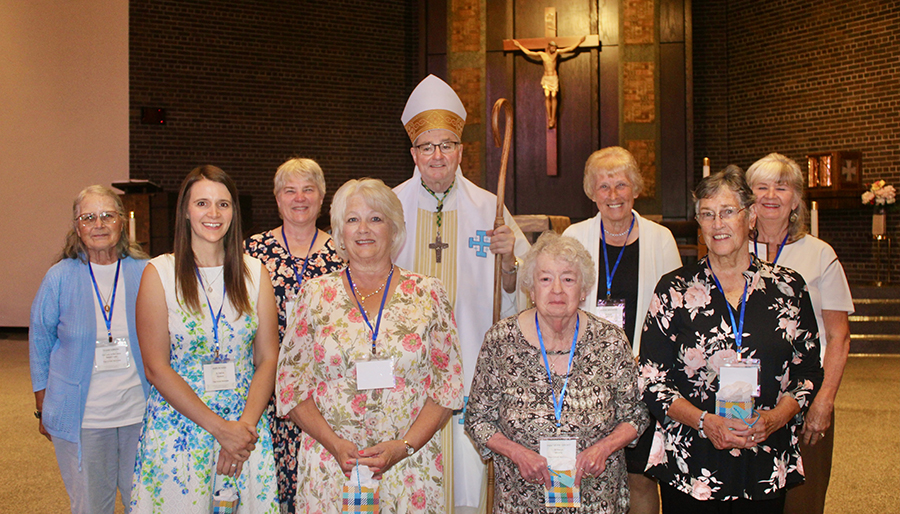
Bishop James P. Powers stands with women nominated for the Superior Diocesan Council of Catholic Women’s highest honor, the Pax Christi Award. They are, from left, Susan Ammann, Our Lady of the Lakes, Balsam Lake; Kari Rynish, St. Patrick, Hudson; Carol Jackan, St. Mary, Bruce; Nancy Thorn, St. Kunegunda, Sugar Camp; Jean Groat, St. Mary, Minong; Ranae Madison, St. Ann, Turtle Lake; Patti McCormick, St. Therese, Phillips; and Valerie Kohn, St. Anthony Abbot, Cumberland. (Catholic Herald photo)
Jenny Snarski
Catholic Herald Staff
The Superior Diocesan Council of Catholic Women gathered for their annual convention at Immaculate Conception in New Richmond on July 23-24. The event featured a Thursday evening talk at a brewery, Mass with BishopJames P. Powers and a keynote by Fr. Isaiah Schick.
With a gurgling water fountain nearby, Fr. Schick, who serves Rice Lake area parishes, began his talk, “Give Me a Drink: Quenching the Thirst of God,” by reflecting on Chapter four of John’s Gospel. He contextualized the passage geographically and chronologically.
“He had to pass through Samaria,” Fr. Schick quoted, and retorted, “No, he didn’t have to, not at least for geographical reasons … The only story we get about this journey is his encounter with the Samaritan woman.” He added how very important that statement is for understanding the passage: “Jesus had other options, but he was going to meet this woman.”
The weary Jesus sitting by Jacob’s well, where he first met Rachel, points to Jesus as the bridegroom himself. When the Samaritan woman arrives, Jesus doesn’t launch into preaching.
By waiting for this “outcast of the outcasts,” Jesus’ focus is not actually on his thirst, but on ours. When the woman finally admits her own thirst and asks for a drink of his water, Jesus responds with an interesting turn, “Go call your husband,” and the truth comes out.
Fr. Schick pointed out the number six – how many men she had been with – and symbolically, Jesus becomes the seventh, the promised fulfillment of God’s covenantal love who provides joy, water and wine, and appears at the opportune moment.
“Before he can satisfy her thirst,” he continued, “she has to realize who he is… the only one who can fulfill and satisfy the desires of her soul.”
Fr. Schick reflected on how often we search for God in the desert of the world.
“More than we thirst for God, God thirsts for us. More than we seek for God, God seeks for us.” He clarified Jesus doesn’t seek her once she’s cleaned up and has her act together. God seeks her while she’s stuck in her sin.
Who is the first Christian missionary to go and tell others she has found the Messiah? The Samaritan woman, known as St. Photina in the Christian East, and celebrated as equal to the apostles. He contrasted her to Nicodemus, who comes to Jesus in the middle of the night.
Photina doesn’t proclaim a physical healing but that Jesus saw her, knew her and loved her, like no man had ever loved her before.
“What allowed this woman to give herself to Jesus was not at first her thirst, but experiencing his thirst first,” he surmised.
He acknowledged it’s easy to stay at the surface level—the warm fuzzies of faith and “God loves you” felt banners.
“But we’re not young kids anymore,” he added, we’ve been jaded by life. He paraphrased a Chris Stefanick quote: Intellectually, we might understand God loves us, but struggle to know deeply that he also likes us.
“He sees your heart like he sees the heart of this woman, the real you, the you that has been unfaithful at times and at others has had infidelities committed against you. He also sees what he made you for … He sees the woman, the bride that he loves, and who he is in pursuit of.”
Fast forwarding to the crucifixion, Fr. Schick asked what Jesus says from the cross. “I thirst, and not just a physical thirst. He thirsts for your heart,” he emphasized.
Relating some of his own vocational experience and Biblical stories like Job, the speaker made clear that God is not upset by our questioning, honesty and brokenness. “We try to fix ourselves before bringing our brokenness to him. We can even be honest and tell him we don’t believe that he loves us.”
He added another common dynamic is stewing in anger and indifference or finding it easier to pray when life is falling apart and finding it harder to seek God when life feels good and easy.
Every sacrament is not just us asking God to give something, but offering God the gift of our hearts, he said.
He ended with two practical tips. One, read and pray with Br. Lawrence’s “The Practice of the Presence of God.” Two, pray the “Pirate Prayer,” so called because it follows an ARRR format: acknowledge, relate, receive and respond.
Acknowledging is being honest, having the courage to look at and invite God into “what is really going on in my heart.” Relating is holding nothing back, giving him all hopes, dreams and disappointments. Receiving, Fr. Schick said, is often the hardest. He suggested praying with the psalms or the Missionaries of Charity’s “I Thirst” meditation.
Responding is giving Jesus the gift of your sin and concrete acts of surrender and charity. Noting it’s hard to explain, he shared that hearing confessions in the Sacrament of Reconciliation is “the greatest joy of my priesthood.”
“We often want to skip to this respond step without doing the others first,” he concluded, but reminded that, like the Samaritan woman St. Photina, Jesus shows the order that works.
Preaching, presentations and awards
Before the Mass, both Province Director Diane Oakland and SDCCW Board member Jane Schiszek spoke briefly.
Oakland expressed her gratitude for all that CCW women do “in your small corner of the world,” calling each one “such a treasure.”
Schiszek, who is also the president-elect for the National CCW, spoke about the gift she looks forward to sharing with women across the U.S. – growing closer to Jesus, faith-filled friendships and service. She also promoted the National Conference, Aug. 26-29 in Grand Rapids, Michigan, as well as next year’s convention in Milwaukee.
Bishop James Powers began the Mass by thanking CCW women on behalf of himself and all the priests in the parishes where they serve.
In his homily, preaching on the parable of the sower and the seed, the bishop encouraged those present not merely to worry about weeds and rocks, but to expand the fertile soil in our souls through prayer and the sacraments.
“The ground can’t by itself change. We can change, but not by ourselves,” he said. “God doesn’t give us opportunities and gifts just for ourselves—he calls us to take them back out to the world.”
He challenged to pray for open hearts and minds, as we receive the gift of Jesus’ body and blood, “to be, a little bit more, that person that God created us to be.”
He also expressed the importance of rejoicing at the gifts received and fruitful harvests borne. Every once in a while, we need to “ring our own bells, so to speak,” he said. It’s okay to be proud as a celebration of the successes and good things we have done.
“If all we do is lament,” Bishop Powers reflected, “how attractive is that to anybody? If people can see the good things we do, they might understand why,” and that just might be the invitation to bring others into closer relationship with God.
Pax Christi Award
After the Mass, Schiszek called forward women nominated for the organization’s highest honor by their local parishes. She announced the four finalists and invited Bishop Powers to reveal the winner.
Finalists for the East Deanery was Nancy Thorn, St. Kunegunda, Sugar Camp; for the South West Deanery, Kari Rynish, St. Patrick, Hudson; Jean Groat, St. Mary, Minong; was finalist for the North West Deanery; and for the South Central Deanery, Patti McCormick, St. Therese, Phillips, was announced as the 2026 Pax Christi Award winner.
Additional nominees were Susan Ammann, Our Lady of the Lake, Ashland; Carol Jackan, St. Mary, Bruce; Ranae Madison, St. Ann, Turtle Lake; and Valerie Kohn, St. Anthony Abbot, Cumberland.
Golden Rose Awards
High school students honored for their community service were: Emily Hill, St. John the Baptist, Webster; Addison Jagielo, Our Lady of the Lakes, Balsam Lake; Shelby Meyer, St. Joseph, Amery; Mallory Smith, St. Anthony of Padua, Park Falls; Ella Ackerman, Holy Rosary, Medford; and Adison Bablick, Immaculate Conception, Butternut.
Scholarship recipients
Each year, the SDCCW awards Mary Jane Morancyk Hennessy Scholarships to women in postsecondary education. The four recipients were: Rebecca Ann Gettleman, middle school English teacher at St. Bridget’s Parish School in River Falls, working toward a master’s degree; Sophia Brunner, Holy Rosary in Medford, studying at Viterbo University; Jennifer Kreul-Buskerud, Holy Rosary, Medford, a special education teacher completing graduate studies; Hannah Houck, Our Lady of the Lake in Ashland, studying at UW-Stevens Point.
Conclusion
The day ended with messages from Bishop Powers and the SDCCW’s spiritual advisor Dcn. Mel Riel, who serves at the New Richmond parish.
Bishop Powers asked the women for their continued prayers and support for priests as they adjust to new assignments. He spoke on the perils of Artificial Intelligence in light of Pope Leo XIV’s recently released encyclical “Magnifica Humanitas.” He said that while it does address AI, it more broadly advocates for a right “understanding of humanity and human dignity.”
The bishop highlighted the need to grow our awareness and cautious use of technology. Without denying the many benefits, he stated that the potential for harm is all too real, noting the ongoing plague of pornography for both men and women.
Dcn. Riel invited participants to continue praying and mulling over the convention’s theme.
“I truly believe that in the depths of our soul is this longing and thirst for God. We each will get to a point where the longing is so real you can taste (it),” he offered, encouraging attendees to ask what prevents us from letting Jesus quench that thirst.
