

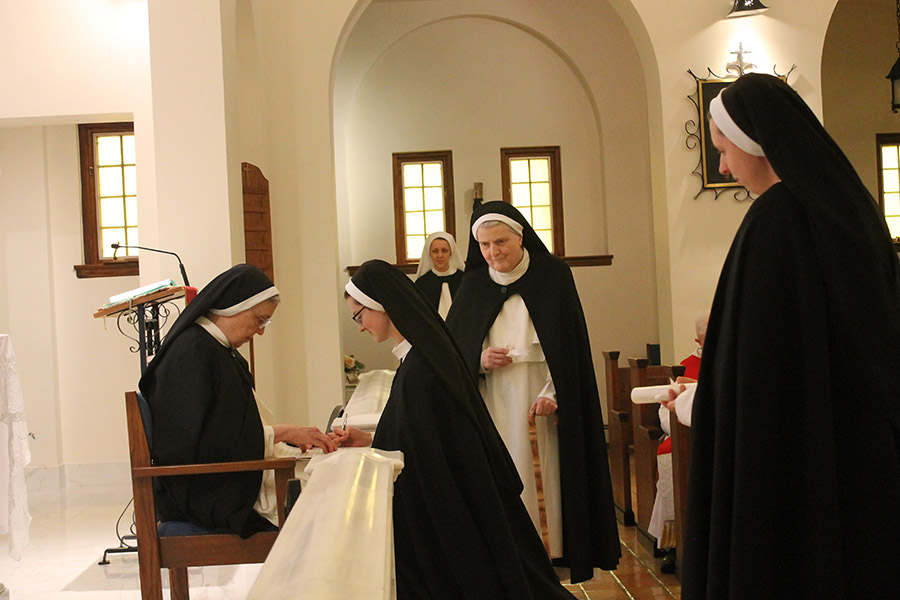
Sr. Mary Pietrina, second from left, made her final vows with the Hawthorne Dominicans in September. (Photo courtesy of the Dominicans)
Aidan Jones
Special to the Catholic Herald
On Sept. 14, a native of the Diocese of Superior made her final vows as a Dominican sister of the Congregation of St. Rose of Lima in Hawthorne, New York.
Born Mary Busse, Sr. Mary Pietrina grew up in Barron, the daughter of George and Anne Busse and the second of six children. She attended school at St. Joseph’s Catholic School in Rice Lake until fifth grade, at which point her family made the decision to homeschool.
The Catholic faith held a central place in the Busse home, and as Sr. Mary grew up, she was involved with youth events both at a parochial and diocesan level. “I was a camper the very first year that Extreme Faith Camp was offered in our diocese,” she recalled. “I was involved with that for many years, and later helped as a high school and young adult leader.”
Sr. Mary also attended Totus Tuus, and eventually spent a summer serving the Diocese of Superior as a Totus Tuus missionary.
Eucharistic adoration played a significant role in Sr. Mary’s spiritual formation and upbringing.
“Mom always took raising us in the faith very seriously,” she explained. “She modeled how important it was to have a prayer life, and how important adoration was for her.”
After Sr. Mary’s older sister received her driver’s license, the two of them signed up for a weekly holy hour at the parish’s perpetual adoration chapel.
“That meant a lot to us growing up, and was the source of a lot of good things,” the sister recalled. “It was nice having that holy hour as a constant in the midst of changing schools, growing up, and being a teenager.”
For her, adoration served as a consistent way to stay rooted in the Lord and receive his graces during the challenges that come with growing up.
Adoration also played a role in Sr. Mary’s vocational discernment. Once, while in adoration at Extreme Faith Camp, she recalls experiencing a deep desire that the Lord would use her for some particular mission. On another occasion, while in her teens, she found herself unexpectedly at the adoration chapel.
“I had been giving Mom attitude, and there was an extra adoration hour that needed to be covered, so Mom just dropped me off!” she laughed. “While I was there, I was talking about religious life to the Lord: ‘if this is really what you want, you’ll need to do this and this and this…’” Gradually, though, her frustrated prayer transitioned to one of surrender. “‘If this is what you want, help me.’”
The first time Sr. Mary remembers thinking about religious life was in third grade. “Before that, I wanted to be a scuba diver or a pastry chef,” she recalled. “But in third grade I wrote that I wanted to be a florist and a nun on a school assignment.” She began to think seriously about religious life while in middle school, and wondered if she was perhaps called to be a sister when she grew up.
“The thought was scary,” she reflected. “I worried about leaving home and family, and about what other people would think. But the thought wouldn’t leave, and occasionally I would pray about it.” When she was 15, she joined a group of Franciscan sisters and other girls her age on a trip to visit shrines, convents and other sites in the Northeastern United States. Included among the convents they visited was the Dominican congregation at Hawthorne.
“Hawthorne was my favorite stop on the whole trip,” Sr. Mary reflected. “I went for a longer visit in my later teens.” The community at Hawthorne is dedicated to caring for the poor who are suffering from incurable cancer; she was particularly struck by this aspect of the community. “The more I was there, the more that nursing touched my heart,” she recalled. “I loved the way the sisters cared for their patients, and how they wanted to see the Lord in them. We went back and forth between the hospital and the chapel, and Jesus was in our midst in two ways: in the Eucharist in the chapel, and covered with wounds in the sick.”
Sr. Mary was also struck by the Dominican sisters’ joy. “I felt at home with them, and like I could be myself,” she recalls. In 2017, she entered the convent at Hawthorne to begin a period of more intentional discernment within the community. “Discernment is a two-way street,” she remarked. “I thought that I was called to be there, but the community also had to discern that I belonged there.”
The Congregation of St. Rose of Lima was founded around 1900 by American author Nathaniel Hawthorne’s youngest daughter, Rose. A convert to the Catholic faith, Rose was 45 years old when she took her first nursing course and began caring for impoverished women who were dying from cancer. Over time, other women joined her, sharing in her work and life. Eventually, Rose was given permission to begin a new congregation of the Dominican order, and took the name Mother Mary Alphonsa. Since that time, the sisters, known colloquially as the “Hawthorne Dominicans” have served those in need while living lives of prayer, community, study and observance of their religious constitution.
For Sr. Mary, life as a religious sister has guided her to greater love.
“You can’t live in community and love others on your own,” Sr. Pietrina commented. “My own love is not enough, and so I need to ask for God’s love. Community life is like a rock tumbler … you wear down each other’s rough edges, and the hope is that you come out beautiful.”
Sr. Mary began learning how to care for patients as soon as she arrived in Hawthorne, a service that has also led her toward greater love.
“The patients have done as much or more for me as I’ve done for them,” Sr. Mary observed. “They’ve shown me what it means to love, to live in acceptance of what God has given, and to love him even in suffering.”
Sr. Mary noted that although it was hard to leave her family, she talks on the phone with them once a week.
“That has been a great blessing for our family,” Anne Busse, her mother, noted. “It has actually brought our whole family closer together, because everyone tries to be present for the phone call.”
Sr. Mary also occasionally travels back home for longer visits. These visits “are a blessing and a joy,” Anne Busse noted, “but also a challenge because [she] has so much to do when she’s home. Everyone wants to see her! She wants to spend time with everyone in the family individually and go to Mass every day … But it’s one big, long joy when she’s here!” Sr. Mary’s younger sister, Jane Busse, agreed, noting that the time she is able to spend with her older sister is special.
“When she comes home to visit, it’s very intentional, and we’re all spending time together,” she related. “I was 12 when she entered the convent, so it was hard not having her around when I was growing up, and took more of an effort for us to stay in touch. On the more positive side, it is fun talking to other religious sisters and being able to say ‘my sister is a [religious] sister too!’”
Jane Busse observed that having a sister in a convent has also been helpful for her own vocational discernment. “It is great having someone close to you in religious life, because it gives you a sense of what it is actually like,” she pointed out. “It’s hard to discern something if you don’t know what it actually is. I have a perspective a lot of people don’t have.”
The entire Busse family was able to attend Sr. Mary’s final vows along with a few friends. “The day itself was something of a blur!” Sr. Mary recalled. “But the joy was just palpable.” A line from the Magnificat kept resounding in her heart: “the Almighty has done great things for me, and holy is His name.”
Practically, not much changes for Sr. Maryy now that she has taken final vows. “Back to business as usual,” she laughed. “But there’s just the gift of knowing that I am all Christ’s. In the day to day, there’s that to go back to, and I know that this is just the beginning.”
When asked what advice she would give to young women who are interested in discerning religious life, Sr. Mary recommended that they regularly spend time in Eucharistic adoration.
“Don’t be afraid to be consistent in having that quiet time of just being with him,” she encouraged. She also noted that a vocation is a gift, rather than something that must be “figured out.” “My vocation was something God had for me, rather than something I had to ‘get right’ or not be happy,” Sr. Mary explained. “Build a relationship of love with the Lord and let him love you where you are right now, so that in whatever way you move forward, you trust that he’s going to lead you.”
Women interested in discerning religious life can find resources at catholicdos.org/womens-discernment.
