

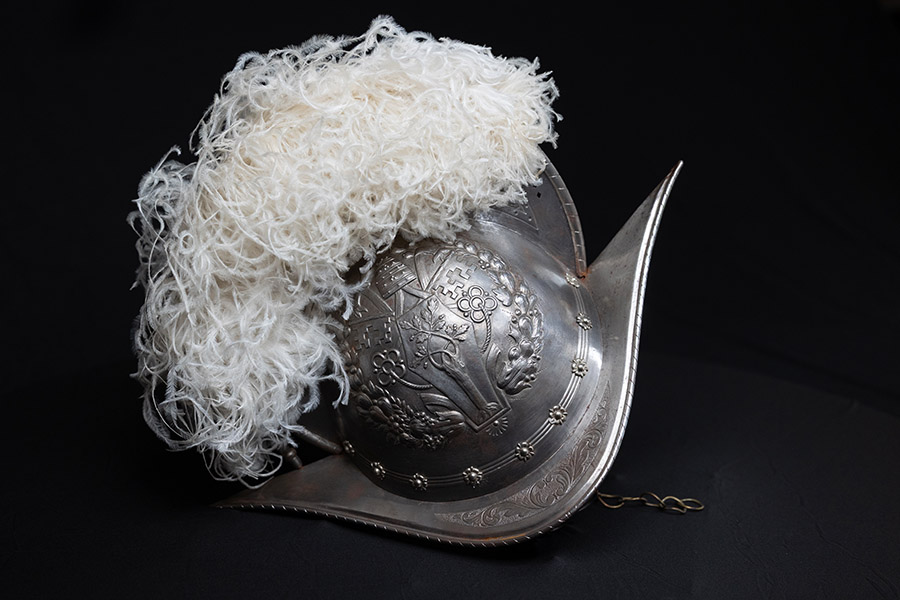
An ornate Pontifical Swiss Guard helmet was one of several artifacts from the armed force and honor guard that protects the pope. (Photo courtesy Archdiocese of Saint Paul and Minneapolis)
Jenny Snarski
Catholic Herald staff
“Bringing the human to life” is one of the primary goals behind Duluth diocesan priest Fr. Richard Kunst’s renowned collected of Vatican and papal artifacts and saints’ relics.
A third of his collection has been on display Jan. 10 through Feb. 1 at the Mall of America in Bloomington, Minnesota, as part of the celebration of the 175th anniversary of the Archdiocese of Saint Paul and Minneapolis.
The exhibit, in a 19,000-square-foot space at the north end of the nation’s largest indoor mall, has been well attended and aims to draw crowds from among Catholics and non-Catholics alike.
While this is not the exhibit’s first run, it the most widely advertised and best attended. For Fr. Kunst, the collaboration with the archdiocese was an opportunity to raise awareness for the importance of historical preservation but also to raise funds for Stella Maris Academy in Duluth.
Among the artifacts are two pieces of homework. The geometry assignment of a young St. Gianna Molla is displayed with second-class relics that were presented to Fr. Kunst in 2017 when the saint’s daughter, Dr. Gianna Emmanuela Molla, visited Duluth.
The philosophy homework of Eugenio Pacelli, the future Pope Pius XII, hits closer to home with the recent election of an American, Pope Leo XIV. Items and stories of when these men were boys echoes the universal call to holiness.
In an interview with the Catholic Herald, Fr. Kunst repeated lines he often returns to: “You can’t love something you know little about.
“As for myself personally, as a curator of this collection, when I come into contact with a new item, I learn as much as I can about it. And the more you learn, the more you love … like the more you learn about the guy or gal you’re dating, the more you fall in love with them … the more you assimilate their good qualities.”
When it comes to the relics of saints, he added, “You feel the connection with somebody when you have something that they own. And so they become more real to you, and more alive to you.”
He said he can’t count how many times people see and spend time with the artifacts and are moved “to great level of emotion … It really affects people.”
“It’s not about the stuff,” he clarified. It’s about the experience of living faith that the collection can offer people.
One of the relics was an item with St. Therese of Lisieux when she died.
“You think of history,” Fr. Kunst reflected, “and you think, this item was there. This was in the presence of a saint when she took her last breath and died. To have something tangible that was associated with that person, doesn’t that bring her story to life?”
Welcoming guests to the exhibit, signage explains of Fr. Kunst, “For decades, he has studied the material culture of the church—objects created not simply as art, but as expressions of belief, devotion, and continuity across centuries.”
According to the exhibit, his collection is the largest and most significant outside the Vatican, reflecting “a deep respect for the church’s historical role in sharing culture, governance, education and spiritual life around the world.”
Clarifying the items have not been collected “for spectacle, but for understanding,” Fr. Kunst’s collection is called “an act of stewardship. These artifacts are not relics of a distant past; they are witnesses to lived faith—handled, worn, used, and revered by generations before us. Through this exhibition, he invites visitors of all backgrounds to encounter history in a tangible way and to consider how belief, tradition and human creativity intersect across time.”
Among the historical items are various conclave seals, from the elections of Pope Paul VI in 1963, John Paul I and John Paul II in 1978. Each seal was affixed to the chains locking one of the Sistine Chapel’s four doors, “symbolizing the solemn enclosure of the cardinals as they gathered to elect the new pope.
Another interesting item is a smuggled letter from papal conclave written in 1730.
There are jubilee medals from 1700-1826 and a medal from 1575 depicting Pope Gregory XIII opening the holy door for that year’s Holy Year.
The oldest item on display is a bone fragment of Pope Victor I, set in an ornate reliquary, one of St. Peter’s earlier successors dating back to 199; Victor served as pope from 189-198. Other artifacts include personal effects of popes: Innocent XI in the 17th century, Leo XIII in the late-19th century, Paul VI and Pius X (early- to mid-20th), Pope Pius XII (mid-20th) and various zucchettos, including one from both Pope Francis and Pope Benedict XVI.
Sizeable items include the traveling trunk of Pope Leo XIII from the 19th century; one of Pius XII’s chairs; two Swiss guard uniforms; and a breastplate and a helmet that bear the coat of arms of Pope Julius II, who founded the oldest standing army in the world. There is also a carbine rifle and pistol and a canon with inscribed dedication gifted to Pope Pius IX in 1848 and various items belonging to Swiss Guards.
Ordination cards of Joseph and Georg Ratzinger, ordained together on June 29, 1951 – customary keepsakes from priestly ordination – are included among other memorabilia of Pope Benedict XVI and his brother.
One of the most recent additions to the collection is a baseball signed by Pope Francis in 2024 and given to Fr. Kunst. It was signed during a brief personal meeting in Rome, chosen by Fr. Kunst as an artifact that was “universal, unexpected, and capable of reaching people who might never engage with traditional religious artifacts,” the exhibit explains. “In this simple gesture, Pope Francis bridged the sacred and the everyday, embodying his belief that faith must meet people where they are.”
There is a voting ballot from Vatican II and a rare Vatican passport created to ensure safe passage for the almost 3,000 bishops and cardinals who came to Rome from around the globe. During the height of the Cold War, this was an “extraordinary gesture of protection by the Holy See.” They served as a sign of unity and diplomatic credential for those traveling from Communist and other politically unstable countries.
Early-18th-century Pope Clement XI owned and prayer with a relic of the true cross of Christ housed in an intricate velvet-lined case. Fr. Kunst said the best assurance of this relic’s authenticity—among the numerous imitations that have surfaced throughout the centuries—is the pope’s ownership and devotion to this tangible connection to Christ’s passion and death.
Asked about future plans for the collection, Fr. Kunst said “We’re just getting going right now.” Ideally, he would like to see the collection exhibited on a regular basis.
“For me, it was a desire to have it not only be an educational thing and maybe a help people enrich their faith, but to help support (a) Catholic school in Duluth, Minnesota,” he added.
He sees the potential as an ongoing funds generator for Stella Maris Academy in Duluth and said he would be open to the collection being hosted in the Diocese of Superior in the future.
For more on the collection, including details on artifacts, papal history and a link to purchase a DVD copy of the 2013 EWTN series that featured Fr. Kunst, visit papalartifacts.com.
