

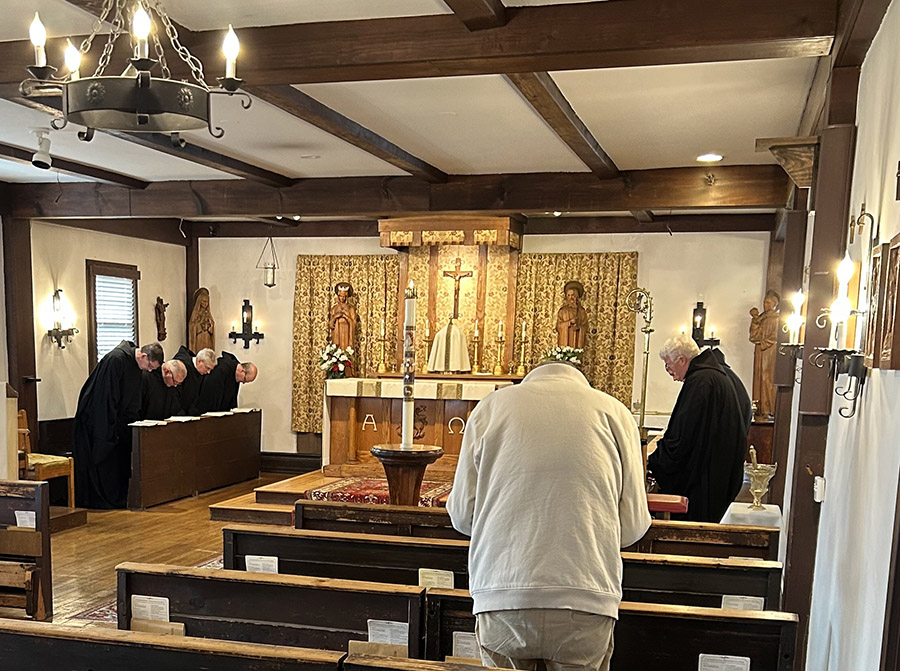
The monks of Saint Benedict Abbey bow during a service at the chapel. The monks pray the Divine Office and the Mass in Latin. (Photo by Joe Winter)
Many years had passed since I last visited the Saint Benedict Monastery, now upgraded to Saint Benedict Abbey, in the foothills of Massachusetts.
That was not the only change to the pair of guesthouses run by the Brothers, now slightly-graying-and-balding men rather than young adults, which is well known to many parishioners on the south end of the Superior diocese.
The carpet was a bit worn from wear, caused by the many footsteps made up and down its almost football-field-length hallway that is lined and packed with relics, photos, elaborate pencil drawings on yellow poster-size paper, many of them portraits of the monks themselves, and other decorations befitting a religious order. Most impressive is a mirror with embossed metal lining and lots of ornate crosses and crucifixes. There are Sacred Hearts everywhere, many emblazoned by plenty of fire coming out of the top, where there also may be a crown of thorns, stabbed with thick daggers and dripping lots of bloody tears.
The nearby swimming house on a lake that greeted visitors, (and featured a rare time the brothers forsook their robes tied at the waist with rope or belt or priestly garb and sandals, depending on their tenure and status within the small Benedictine community) had been sold, but the monks were still joyous to see me at the monastery, as they are in their several-times-daily chanting. (I reminisced greatly and with a tear as I both visited, attended Mass and penned this piece.)
Beforehand, when they were brothers and not many titled “father,” going back to the past millennium, a group of them started traveling to Hudson every summer for a week or two to visit and press the flesh with major donors in the area for their monastery, which has big buildings that are solidly constructed (as was the order of business in colonial times), but unlike many of them simple and scaled back so as to be inexpensive. Carol Landry, a parishioner at St. Patrick’s Church, would each July play host.
Landry, though now past retirement age, still is an active volunteer at the church, among other things cooking up elaborate meals and at Thanksgiving delivering them to homebound people – so the role of hostess fits her – with fare that was far fancier than that served up at the monastery, although what was there is plentiful and beautiful in its stripped-back simplicity, like the whole experience.
When have they last crossed paths? As the decades went on, the contact waned bit by bit, as the brothers were just getting too far into middle age and beyond to run the road, although Christmas cards and an occasional phone call are still exchanged. One more change from the days of being young and more eager monks. Daily prayers starting at 6 a.m. was enough.
The adjacent small fruit and vegetable and jelly stand with big bins run by a group of like-minded nuns and located across the way, along the rural road in the foothills spreading out 30 miles from Boston, is no more, and the fields cut with thresher leading across descending hill and dale and very old-fashioned farm hosting a few dozen head of cattle is no longer tended.
But still the monks worship and are gracious with omnipresent smiles and accommodating to the visitors, sometimes sent their way by local bishops if travelers have no place to stay, squeezing in short chapel services about the spoken-singing of The Hours almost every other hour; the main of the such services are held three times each day and have sometimes elaborate titles, such as The Divine Office. They start at 6 a.m.
This is except on Saturdays, when the ritual is cut short by an early evening showing with the guests of G-rated, family-oriented movies still run by projector. (There used to be the late Friday night basketball game on a half-court tile floor that was on one end of the barn, even with a small kitchen, with the brothers and a few other men from the immediate area playing with unusual competitiveness while still in their robes, in this, which was formerly the parish hall. This was for the town of Still River, a burg that you otherwise would never have known existed.)
Sessions are held to the odd sounding, and supported by, art pieces Devotion to the Holy Face (of Jesus), and how does one practice it? The mission statement on a nearby wall uses archaic terms comparing the brothers’ devotion to being in slavery to the Immaculate Heart of Mary.
It is kind of like a step back in time. Even the bell tower that has a big wheel alongside to run it, along with its high four-legged tower with shrubs in the middle and wooden studs slotted as slats between.
The two large guesthouses and a barn and a main building (that houses the rather big dining hall and commons area, and the chapel and the brothers’ end bedroom quarters) on the other side of a long gravel path are likewise present in the buildings by themes of Trinitarian threes, whether it be the number of building additions, and the trio of windowed, roof-covered, narrow hallway routes winding to the Old School chapel.
It all looks and feels very Gothic.
The prayers and hymns are in Latin, largely, or modern and old English or a combination of both, and the languages used seem very quaint and decidedly medieval. Some of the older attendees are now having trouble kneeling and bowing, so they stay seated much of the time in the single row or sometimes two of pews, facing sideways, alongside the small but wide altar and Blessed Sacrament complete with decor on the back wall that is many centuries old.
The small number of guests at one time are a disjointed conglomeration of largely odd professionals (particularly architects interested by the old buildings) and academics and a few housewives, often married people who spend retreat time away from their spouses and children. This is what dinner conversation, always attended by a monk or two, often is centered, as all of these people are decidedly Catholic. The guest houses have become more modernized with some ceiling lights, among other things, but feature a small bed and desk for study or pleasure reading. The houses may serve as a weekend retreat location for teen youth from across a large area, and in back of one on a sparse, slightly slanted lawn is a net for volleyball, under a large oak that protrudes into what serves as a court.
Off past the parking area, now paved, are the big hayfields and a pasture, followed by a miles-long stretch of woods that leads up to a valley and then off to another small mountain, which one can see decorating the sunset.
