

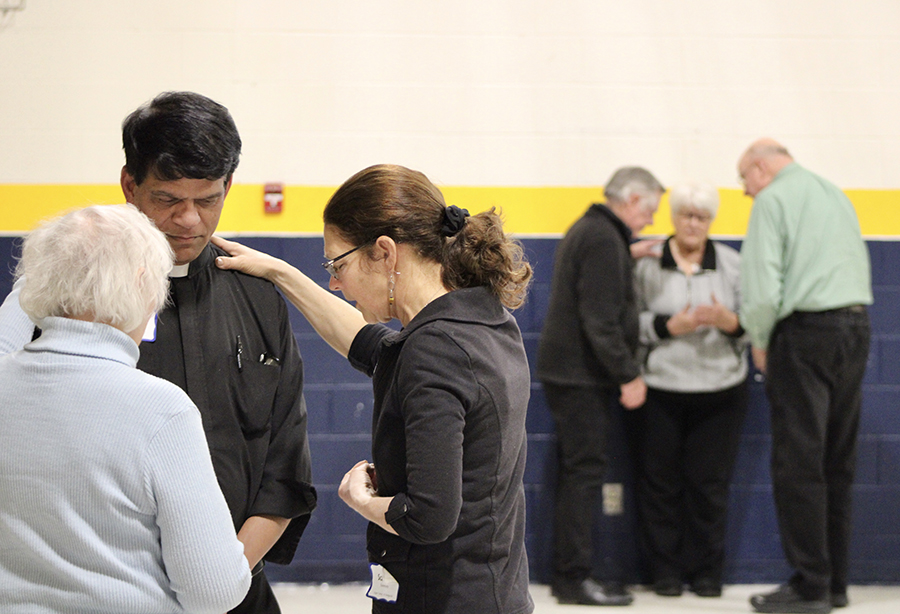
During the workshop in Rhinelander, participants—including diocesan and international priests—engaged as small groups in giving and receiving intercessory prayer. (Catholic Herald photo)
Jenny Snarski
Catholic Herald Staff
“They say that repetition is the mother of learning and the father of action,” Chris Hurtubise, director of the Diocese of Superior’s Office of Evangelization and Missionary Discipleship, commented on the recent Parish Evangelization Team Spring Workshop.
This annual training was presented at St. Joseph, Rice Lake, and Nativity of Our Lord, Rhinelander, on April 11-12 to facilitate participation across the diocese. Hurtubise added that the intended audience has broadened, offering a “resource of training and equipping to the faithful of the diocese at large.
“Bishop Powers’ vision is that we become a diocese of apostles (those sent to evangelize)… Moving forward, we hope to provide equipping tools for that mission,” he said.
Presenter Ryan O’Hara, of St. Paul, Minnesota, was invited to teach the faithful about presenting the Gospel through personal testimony in everyday life.
O’Hara, with visual and print aids, used a quote from Pope Francis’ Evangelii Gaudium as the starting point for each of his three talks.
From paragraph 128, “In this preaching, which is always respectful and gentle, the first step is personal dialogue, when the other person speaks and shares his or her joys, hopes and concerns for loved ones, or so many other heartfelt needs. Only afterwards is it possible to bring up God’s word, perhaps by reading a Bible verse or relating a story, but always keeping in mind the fundamental message.”
He shared that in 30 years of ministry, he has yet to find a better summary of evangelization and proceeded to unpack the pope’s words and explain how it can be applied.
Step one is to “give precedence to receiving the other person completely.”
“Only afterwards is it possible to bring up God’s word,” the speaker iterated as the second step.
“The only good news for all,” O’Hara stated—after a reflection on the Gospel passage of the disciples’ encounter with Jesus on the road to Emmaus—“is that Jesus Christ is risen… This kind of news isn’t an alert, but it reaches into our life and demands a response.”
“The One who sent the message waits on our response,” he added. Those first responses propelled Christianity throughout history; O’Hara affirmed that same committed response is what attendees, and all Catholics, are still being invited to today.
“Everyone of us has a unique angle on God’s goodness and beauty. Each one of us represents unique aspects of who God is,” he said. In a moment of grace, each person receives a message from God intended to be shared with others. He said we need to have “our spiritual antennae up to observe this.”
With a focus on listening for those moments of grace and openness, O’Hara spoke of sharing the experience of Scripture’s impact or one’s personal testimony.
Stories were a tool Jesus often used. They “can smuggle big ideas in,” are “sticky” and pass from one generation to the next. Where arguments and information can lead to people “checking out,” O’Hara said that stories “help people lean in.”
He noted how in this internet generation, “argumentation is the language that has the greatest hold.” While the internet has lots of answers, O’Hara affirmed that “people want witnesses; they need reasons for hope.”
Participants were given an exercise to work on individually to create a one-sentence testimony starting with: “I know in my life God has ___.” They were encouraged to hone in on the one essential idea that makes it memorable and portable.
Responding to an audience question asking what if a person hasn’t had a monumental conversion experience, O’Hara invited to reflect on personal “bursts of growth that propelled you deeper in faith.” He added that the exercise was also an invitation to prayer and asking to see God’s continuous and providential action in one’s life.
“God’s voice is loud enough to hear if we get quiet enough to listen,” O’Hara offered.
Moving to a talk and exercise on praying with others, the speaker presented three optional responses to a request or inspiration to pray with and/or for someone: “Pray later, pray now, pray never.” He admitted how easy it is to promise prayer and forget later.
Offering “systems for our commitment to pray for others” that follow the ideal of praying now, O’Hara said it honors the other person’s request and becomes an opportunity for encounter. The easily recalled formula he gave for spontaneous prayer with others was G.I.V.—gratitude, intimacy and virtue.
Practically, it includes “be brief, be bold, be done.”
“What do you want to ask of God?” is the question to be posed to the person requesting or in need of prayer. O’Hara suggested asking permission to lay a hand on the person’s shoulder or arm in line with the ancient Christian practice of laying hands.
Groups of three were formed to practice the method, each taking turns to offer and receive the prayer. The third person was to “agree as the Spirit moves,” repeating a word or praise or simply being present to the prayer process.
The discomfort of this outward form of prayer was acknowledged beforehand. After the exercise, there was unanimous agreement that the experience was better than imagined.
Hurtubise observed, “For many, this was initially uncomfortable, but Ryan did a fantastic job preparing us and leading us through an experience in which all participants prayed with and for each other.”
He said that feedback has been excellent—these workshops are truly “equipping the diocese to answer the call” to evangelize as one participant relayed. Hurtubise’s hope is that those who attended not only put into practice what they learned but also pass it along.
