

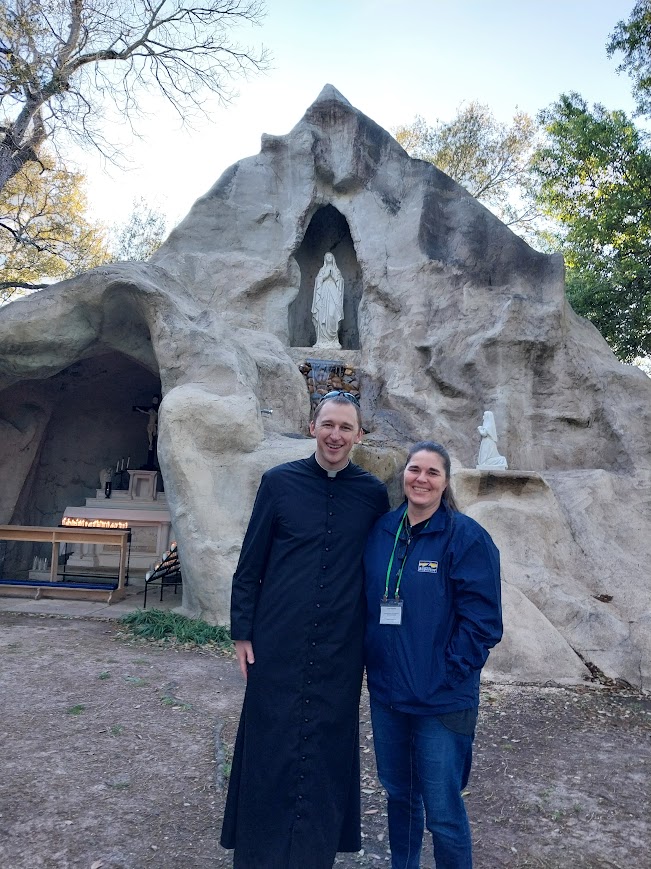
Fr. Dan Tracy and Diocese of Superior Associate Director of Evangelization and Missionary Discipleship Loree Nauertz pose during their March visit to Louisiana to attend the North American Marriage Catechumenate Summit. The event focuses on implementing the Vatican’s new vison for marriage ministry in the U.S. and Canada. (Submitted photo)
Anita Draper
Catholic Herald staff
A universal re-envisioning the Sacrament of Matrimony in the Catholic Church is the goal of the Marriage Catechumenate, a Vatican initiative that is trickling down from popes to bishops through dioceses and into parishes.
In the Diocese of Superior, a clergyman and a laywoman are bringing the message home.
Fr. Dan Tracy, parochial vicar at St. Patrick, Hudson, and Loree Nauertz, the diocese’s associate director of Evangelization and Missionary Discipleship, attended the North American Marriage Catechumenate Summit March 16-18 in Grand Coteau, Louisiana.
Hosted by the Witness to Love marriage preparation program, the summit offered talks, discussion and an ideas exchange among its participants, which included clergy, diocesan leaders and those working in marriage ministry.
Shifting toward marriage
Traditionally, marriage preparation has included meetings with clergy, a retreat, classes or some format where information is imparted from church to couple. The vision of the Marriage Catechumenate is, by contrast, an accompanying of couples throughout engagement and marriage similar to the way Order of Christian Initiation of Adults catechumen are mentored through the conversion process and welcomed into the life of the parish community.
Marriage preparation has been increasingly layperson-led over the past 40 years or so, Fr. Tracy explained. The most consistent complaint has been that couples get married at a church but don’t live in the church or have a relationship with the church.
Divorce rates are high. Marriage rates are low. Catholic marriage rates are low. But Fr. Tracy is not worried.
“I’m not discouraged at all by the lack of marriage,” he said. In his mind, the numbers just indicate there’s demand.
In his three years of meeting engaged couples, the priest has found the view is generally that someone who wants to be married in the church goes to the church to get ready for the wedding.
“I will tell you that a huge shift needs to happen … we need to, for those of us who are ministering to married couples and engaged couples … we need to shift priority from celebration of the wedding,” he said.
When Fr. Tracy talks to couples, he is consciously aware of not using the word “wedding.” He is accompanying couples, walking with them, helping them to consider whether marriage is the next step for them.
The goal of marriage preparation is not to give couples all the information they will need in marriage, because that’s not possible, he observed. The goal is to get them committed to the marriage and the church and their parish, because they will get the formation they need through the parish.
The catechumenate approach is an implementation of the teachings of both Pope St. John Paul II and Pope Francis. Basically, the Marriage Catechumenate envisions “something more robust” than a few quick classes —a sort of lifelong preparation that starts at baptism and continues until death.
“It’s a complete rediscovery of what Christ and the church have intended,” Fr. Tracy added. At the summit, as was iterated endlessly, “It’s absolutely not a new program, not a changing of terms. It’s a fundamental rediscovering
of the vocation of marriage in the church.”
Witness to Love
Having just celebrated 30 years of marriage to her husband, Al, Nauertz and her husband are exactly the kind of faithful Catholics who can offer mentorship to young couples. That’s the format of Witness to Love, a marriage preparation program that creates a foundational support system for newlyweds by pairing an engaged couple with the mentoring couple of their choice.
“It’s a virtues-based model where they come together, the mentoring couple and the engaged couple, at least once a month,” Nauertz explained, and the plan is also for them to connect outside church. The first job is for the men to plan a double-date with the women.
“It connects them,” she said.
Witness to Love has been integrated into several parishes in the diocese, including Fr. Tracy’s parish of St. Patrick, Hudson. If an engaged couple “has lifelong friends who are also faithful Catholics, and that’s going to bear fruit for them through eternity,” he believes.
The mentoring couple must be at least five years married, involved in the church and in a marriage the engaged couple admires. They couples don’t have to know each other.
Fr. Tracy’s prayer is, “Lord, give this couple the right mentor couple.”
For him, seeing the fruits of those relationships has “been one of the most beautiful parts of my priesthood.”
Western cultural shifts in recent decades have moved away from Christianity, strong, supportive communities, intergenerational friendships and an understanding that marriage is a lifelong commitment. To some degree, the Marriage Catechumenate model compensates for what is lacking.
At the summit, Nauertz appreciated that people “get the reality of this culture we’re living in right now.”
“First of all, we’re not in Christendom anymore,” she said. “The culture doesn’t encourage or clearly understand what marriage is.”
On Witness to Love, she commented, “They’re finding an incredible amount of success with it.” A high percentage of couples are coming to Mass during engagement and marriage,” and then, when things get hard, they’ve already established a relationship and then hopefully they feel comfortable coming to them.”
Friendship is the first determinant of success in a marriage, she said. In her own marriage, she and Al were best friends, and the relationship felt easy. There were no problems.
“Until there were,” she added.
Like all couples, the Nauertzes have had to work through their share of conflicts, but what she learned through another program, Marriage Encounter, is that marriages start at romantic, go through a disillusionment phase and then come to joy.
Now in her fifth year working with the diocese, Nauertz said she has developed a better understanding of where parishes are at and sees the opportunities for enriching family and marriage. She felt affirmed by what she heard at the summit.
“We are all trying to figure this out in a culture,” she said. “We’re so busy, and … God, faith, church, religion is just another thing on the calendar and not a relationship.”
The summit was also an opportunity, in the style of Pope Francis’ emphasis on synodality, to come together and discuss how to implement the Vatican’s vision.
Fr. Tracy called it “one of the best experiences…. listening, dialoging, sharing, discussing topics. It was not a lecture,” he added. “It was more seminar focused.”
In the Diocese of Superior, as in nearly every other U.S. diocese, the Marriage Catechumenate model is spreading from the ground up, Fr. Tracy explained. Individual parishes are changing their preparation programs, and the model is replicated as parishes learn from one another.
The Diocese of Lincoln, Nebraska, is the only diocese making the change via a top-down structure, where the bishop has implemented the Marriage Catechumenate program at the diocesan level and parishes are following the lead.
“It’s really beautiful to hear what they are doing,” he said, and the “recent fruitfulness in their church” that has followed.
Fr. Tracy quoted the founders of Witness to Love, Mary-Rose and Ryan Verret: “’Evangelization moves at the pace of a relationship.’”
He feels the sentence gets to the heart of the fundamental shift now taking place, and Catholics who feel discouraged by marriage and family statistics or current cultural norms should take heart.
“I think that it is very easy to look at the state of marriage and family life, both in church and in the broader society, with despair,” he agreed.
Instead, the priest challenges the faithful to look ahead: “We’re in a great moment of hope. We’re in a great time where eyes are being opened to the great beauty [of marriage] …. There are people who have courage and hope and want to see more from the church, want to see more from the voices of married couples and families…. There’s no more fundamental investment than I can make as a priest.”
“Marriage and family is the most fundamental work,” he iterated. “Fundamentally, this is where our energies need to be devoted, and we can do it together. That’s the beautiful thing.”
