

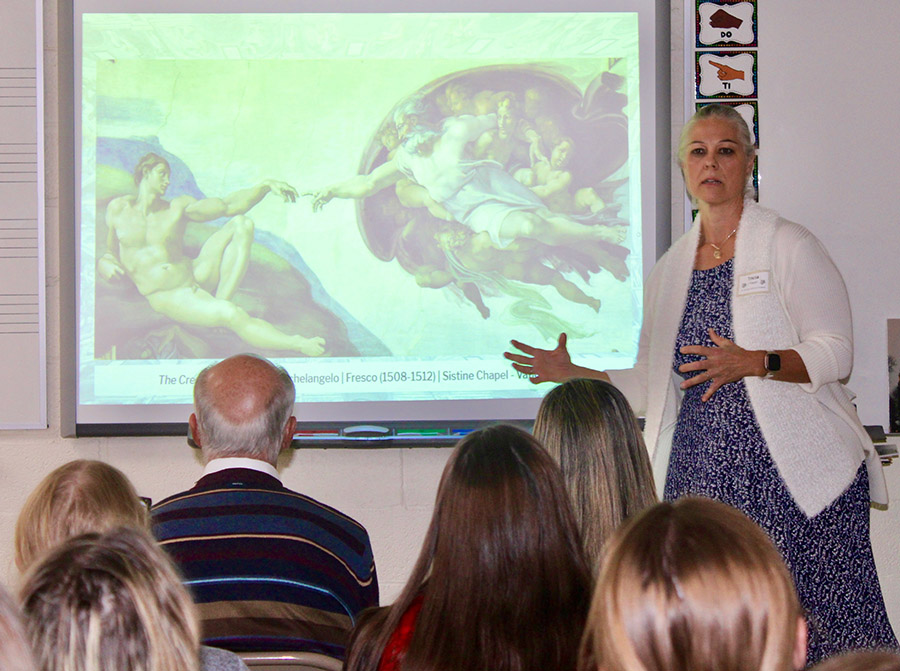
Tricia Pieper, a teacher at Hudon’s St. Patrick School, presents a workshop on Faith in Art for the Diocese of Superior’s Fall Conference at St. Joseph School in Rice Lake. (Catholic Herald photo)
Jenny Snarski
Catholic Herald staff
Tricia Pieper, art and religion teacher at St. Patrick Catholic School in Hudson, presented two workshop sessions of Faith in Art for the 2025 Fall Conference in Rice Lake on Oct. 24.
As attendees arrived to the music room at St. Joseph School, they were treated to a slideshow of deep space images from the Hubble telescope accompanied by instrumental music.
“God is the artist,” Pieper emphasized. She commented on photos of star-smatterings, swirling galaxies and space dust sculptures, describing how awe-inspiring God’s creation is; in particular, how spectacular the creation of each person is in light of this universe so full of wonder and mystery.
After the morning keynotes on artificial intelligence and technological advances, Pieper spoke about beauty as “a path to truth and goodness” and an opportunity to re-engage with the transcendentals. Counteracting the advancing tide of mechanization, connecting art with the pursuit of faith becomes an increasingly important opportunity in educational and catechetical settings.
The Catholic catechism addresses “Truth, Beauty and Sacred Art” within the topic of the eighth commandment, forbidding misrepresentation of the truth. Reflecting on respect for truth and means of communication, the catechism recognizes the role of beauty as part of truth’s splendor, “above all, when it is a matter of evoking what is beyond words: the depths of the human heart, the exaltations of the soul, the mystery of God” (CCC #2500).
Creation and God’s works of wisdom—the order and harmony of the cosmos and man, created in his image—include art as a distinctively human form of expression, one that “bears a certain likeness to God’s activity” when inspired by truth and love.
Pieper quoted #2502 on sacred art that, corresponding in form to its particular vocation, evokes God’s glory and his transcendent mystery. It finds its ultimate expressions in Christ and the spiritual beauty of the Blessed Virgin: “Genuine sacred art draws man to adoration, to prayer, and the love of God, Creator and Savior, the Holy One and Sanctifier.”
The catechism goes on to advise bishops to promote sacred art, old and new, in all its forms, and to remove from the liturgy and places of worship “everything which is not in conformity with the truth of faith and authentic beauty of sacred art.”
Pieper clarified, “Art is not just visual.” It includes vocal, audio and even with modern technology, video art forms. To exemplify, she played a video of light moving through Washington, D.C.’s National Cathedral available on YouTube; what photographer Colin Winterbottom captured on silent video had music added after an original score was written by composer Danyal Dhondy.
Pieper asked what it is that makes stained glass so beautiful, asserting it is not the windows in and of themselves, but the light shining through.
“Great art is nothing without God shining through it,” she said, reflecting also on the metaphor of the varied effects from the light shining, both inward and outward.
Sacred art, she said, is the result of the Spirit inside us shining outward.
Referencing the Catechism again, Pieper spoke about the superabundance of the inner riches of human beings: “Art is not an absolute end in itself, but is ordered to and ennobled by the ultimate end of man” (CCC #2501).
In her own words, Pieper defined art as “a form of practical wisdom, uniting knowledge and skill, to give form to the truth of reality in a language accessible to sight or hearing.” She then guided participants through exercises in visio divina, audio divina and video divina.
With images of the Sistine Chapel, she explained significant elements of Michaelangelo’s painting of Adam and God the Father, the famous two hands almost touching. Pieper noted, God is the one taking the initiative to reach out toward the first man, with Eve and even the Christ child under his arm, waiting to come onto the scene in human history. She showed how, in one image, the “whole plan of salvation is present.”
Pieper also guided a brief meditation on Andrei Rublev’s “Trinity” icon, which is not painted but “written,” as the process of making an icon is described. She pointed out artistic devices like linear perspective and subject positioning that speak to spiritual messages that invite the viewer “to a place at the table.”
She explained how she uses images and music with her students, in particular as a complement to their Theology of the Body curriculum, putting themselves into scenes, resting in contemplation and responding in relationship to God. She also noted how enriching it is done in a group, where one person notices something no one else did, each personal interpretation adding to the experience of all individuals.
For the audio divina exercise, Pieper offered some information about the psychology of resonance in music and parasocial emotion regulation, how people use art to feel, understand and process heavy emotions, even subconsciously.
“Music mirrors,” she said. “It holds space” for certain emotions that are too difficult or profound to put into words, and remind us that we’re not alone.” She acknowledged that fiction and poetry can act similarly.
Pieper played a recording of Beethoven’s Symphony No. 5 as an example and asked for input from the group. “Music can be difficult to express in words,” she said. “It’s bigger than our bodies can contain” and helps us to blossom in nonverbal ways, including our resonance with the movement of the Holy Spirit in prayer.
A video cartoon story with music, although unnarrated, was the subject of the video divina exercise. “The Duet” by Glen Keane uses classic animation and virtual reality to create a story without words that each viewer can engage with meditatively.
Pieper concluded by sharing from Pope St. John Paul II’s 1999 Easter Sunday Letter to Artists. In the Holy Father’s closing paragraphs, he states, “Beauty is a key to the mystery and a call to transcendence. It is an invitation to savor life and to dream of the future. That is why the beauty of created things can never fully satisfy, it stirs that hidden nostalgia for God.”
