

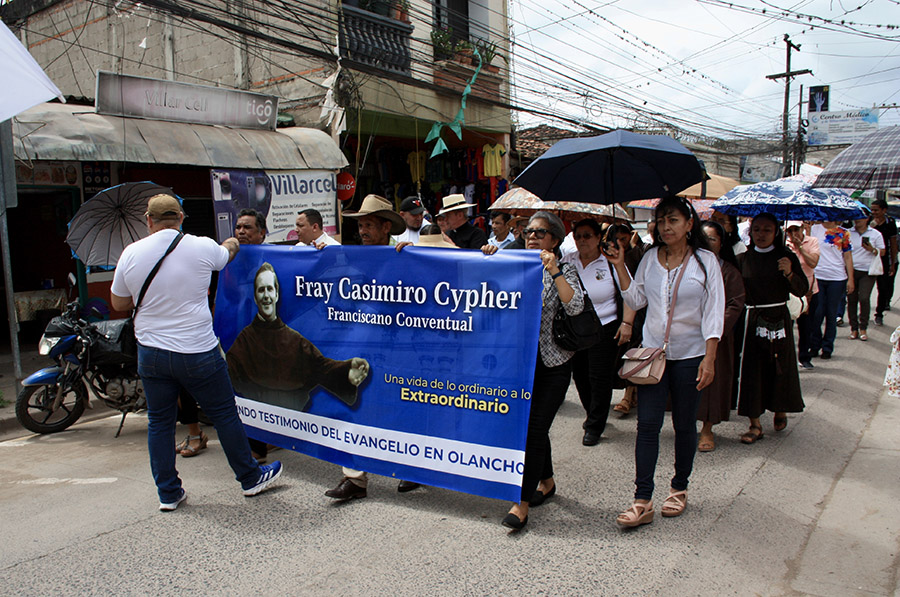
Boulevard of the Poets to the Cathedral of the Immaculate Conception in Juticalpa on the anniversary of the massacre, June 25. (Submitted photo)
Jenny Snarski
Catholic Herald Staff
In 1975, Daniel Brandner was 15 years old when he heard his grandmother say “something bad” had happened to Fr. Casimir Cypher, OFM Conv., his grandfather’s first cousin. Young Michael Cypher had left his home and family farm in Medford after eighth grade for seminary and later missionary work in Honduras. Brandner, whose mother was a Cypher, had never met Fr. Casimir, but he was invited to follow in the priest-martyr’s footsteps in Honduras this June, for the memorial activities to mark the 50th anniversary of Fr. Casimir’s martyrdom.
“I was curious,” he admitted, mentioning his interest in travel and foreign cultures. Brandner, who lives near Eau Claire, knew a bit of Spanish from a previous trip to Guatemala and being retired, figured, “This was a once in a lifetime opportunity to walk in the footsteps of Fr. Casimir, meet the people he ministered to and experience the land and culture of Honduras.” Brandner, the first of the martyr’s relatives to visit Honduras, traveled with Medford cluster pastor Fr. Patrick McConnell on June 23-27. They were escorted in-country by Fray Juan Pagoada Acosta, OFM Conv., vice-postulator for the Wisconsin-native’s cause for canonization that opened six years ago.
Fr. Patrick McConnell’s motivation for the trip was “to honor one of our own as a witness to the faith.” It was an opportunity to better understand Fr. Casimir, an alumnus of Holy Rosary’s parish school, the cause for his canonization and to make connections with the communities where he served. The Cypher family raised their children on a farm southeast of Medford. Fr. Casimir has a headstone in the cemetery where his parents are buried at Stetsonville’s Sacred Heart Church.
Three of Fr. Casimir’s siblings are still alive: Joseph Cypher, of rural Taylor County; Mary Ann Engel, of Chippewa Falls; and Venard Cypher, of McFarland. It was this older brother, Venard, whose path Michael followed to the Franciscan seminary. Ordained in 1968 as a Conventional Franciscan, Fr. Casimir’s first assignment was a parish in Rockford, Illinois, but felt his calling was to serve the poor as a missionary. Inspired by the missionary work of fellow Wisconsinite Fr. Emil Cook, he was transferred to a parish in California to learn Spanish and in 1973, sent to Honduras.
Fr. McConnell and Brandner visited with the elderly priest while in the country. Fr. Cook, originally from Milwaukee, was working in the Olancho region of the country, a rural state (or “departamento”) whose economy depends largely on farms and ranches. He was busy starting schools, so young friar Casimir was tasked with pastoral care and sacramental ministry for the local Catholics, peasant farmers or “campesinos,” working for the rich landowners. He often visited their remote communities on horseback.
A year after arriving, Fr. Casimir contracted a blood infection that had to be treated in the United States. Despite growing political unrest in Honduras, he returned to serve his people, knowing his life could potentially be in danger. Although he never learned the foreign language well, Fr. McConnell was moved by the many firsthand accounts of people who had known the missionary personally.
“One of the things that was so clear,” he said, “was how personable, how friendly and how kind Fr. Casimir was to everybody. Everyone we talked to referred to him as a friend. Yes, a gringo from northern Wisconsin who barely spoke Spanish, but they loved him because he was so close to the people.” They heard stories about how dedicated and resourceful he was in his attempt to build a church in Gualaco – unfinished before his death but where his body is now laid to rest. There were stories of physical pain and injuries he pushed through, his humor and humanity – all in all, “a generous servant.”
Fr. McConnell commented that the witness of Fr. Casimir has been influential in an increase in native Honduran vocations to the order. Brandner and Fr. McConnell were able to meet many of these men during their time in Honduras, specifically at the Franciscan convent in Campamento; many recall stories of the saintly American from when they were boys themselves.
Staying with Franciscan communities during their stay, Brandner described their rooms as “spartan,” but was grateful for flush toilets and showers. He added, “With clean sheets and towels, what more could we desire?” Commenting on the Franciscan vow of poverty, he said of these religious, “They have everything they need, and are richer in the spiritual graces that we all long for.”
Campamento is also where the Fray Casimiro Technical School has operated since 1991, serving the disadvantaged in various skills, “both technical and spiritual. Its goal is to provide marketable skills and high school diplomas to students.” The institution is connected with a parish in Texas that has supported them financially since 2008. The school also runs a water purification plant as a business and funding for educational scholarships. For the week of Fr. Casimir’s anniversary of death, photos of his life were displayed.
With Fray Juan, the two men retraced Fr. Casimir’s route that fateful day of June 25, 1975. Having brought his truck to Juticalpa for repairs, the 34-year-old friar crossed the plaza towards the Santa Clara community center. Brandner told how the military police were rounding up wanted campesinos, some being shot when they tried to run. He has pictures of bullet holes still peppering the colorful plaster walls of the now-vacant building. Fr. Casimir’s arrest was followed by humiliating and horrific torture. He was then killed with others along the road outside of the town at a place known as Horcones, where a large metal cross now marks the site. There is also a sign with the 14 names of the people murdered, their bodies thrown into a well and then blown up to hide the evidence.
Today, plaques with these 14 names – Fr. Casimir’s always heading the list with another priest, Columbian Fr. Emilio Betancourt – can be found in churches around the region and throughout the country. One of the signs Brandner photographed says, “Perdonamos pero no olvidamos”; translated, it means, “we forgive, but we don’t forget.”
The situation between the government, the poor and those who serve the needy can still be fraught with tension, although Fr. McConnell was grateful the processions and Masses were allowed to proceed without incident.
Processions took place near the Immaculate Conception Cathedral in Juticalpa and later that same day in Gualaco. Brandner described how a truck led the crowd with speakers that played music. “In between songs, a reading of the list of martyrs was repeated, with the cry of ‘Viva!’ (long live!) after each name.”
Fr. McConnell said that there were three stops along the procession route with readings performed by young friars. “Listening to this young Franciscan friar reading in the voice of Fr. Casimir about his childhood in Medford, Wisconsin, was so cool,” he emphasized. “Surrounded by hundreds, all there because of this man.”
He recognized the honor for Brandner being present as a family member, seeing the fondness these people had for his cousin. This whole region, Fr. McConnell added, “has been inspired profoundly by his life, but I would argue that all of Honduras was.” He said the massacred was commemorated annually all over the country, in particular for this 50th anniversary.
Almost 30 priests concelebrated a memorial Mass at the cathedral led by Bishop Jose Bonilla. A second celebration and memorial Mass were offered at San Jeronimo Church in Gualaco with Bishop Jenry Ruiz of the neighboring diocese. After Mass he prayed, along with others, at the tomb of the American priest, where a commissioned painting of the martyr was mounted. Brandner called them “powerful moments.”
The tomb reads: Fr. Casimir Cypher, OFM Conv., with the dates of his birth and death. Beneath this appears the phrase “Martyr for Justice” and a Scripture passage in Spanish. 2 Corinthians 4:8-9 reads, “We are subjected to every kind of hardship, but never distressed; we see no way out but never despair; we are pursued but never cut off; knocked down but still have some life in us.”
Fr. McConnell commented on how the cause for Fr. Casimir’s canonization focuses on his love for the poor. Although his death coincided with a period of national political upheaval, he was not a political protestor but a servant of those seeking justice and a livelihood. The local bishop has made clear the martyr’s witness is that of a man who loved God and his people.
Fray Juan later visited Medford. He celebrated a Mass at Holy Rosary on July 20, the 50th anniversary of Fr. Casimir’s funeral. He gave his first-ever homily in English (with much help), but he was pleased when parishioners applauded his efforts. His visit was to continue gathering information for the cause and included a visit to the Franciscan Province of Chicago, where Fr. Casimir had first been assigned, and the Rockford parish where he lived. Fr. McConnell accompanied him to visit Fr. Casimir’s brother, Venard, who is confident his brother will be named a saint one day.
Acknowledging that Fr. Casimir is not the only well-known priest from the Diocese of Superior to live heroic virtue, Fr. McConnell said, “For us to be able to say, from this place – from the Diocese of Superior – these great people came.
“You come from this place,” he continued referencing his parishioners and other Catholics around the diocese. “They were just like you, and they did holy and amazing things for Jesus … You could do that, too!” He said that over his days in Honduras he came to know the man and to love him. He was a poet and artist, a real guy.” His hope is now to continue collaborating with and help the cause for canonization to move forward.
Bishop James P. Powers also met Fray Juan in person during the July visit, an important step as the approval of the local ordinary is needed by the Vatican from each diocese where he lived. Fray Juan is still in the lengthy and labor-intensive state of gathering witness testimonies from those who knew him as a boy, seminarian and young friar. He will be returning to Chicago this October to visit the Franciscan Province’s archives for Fr. Casimir accompanied by Brandner.
For Brandner, what began as an initial curiosity about a notable family member, researching and recording the life and legacy of Fr. Casimir has become much more. It has also sparked his own interest in the various Franciscan religious orders and their spirituality. He maintains a website with extensive resources and links, casimir.danbrandner.com. A detailed slideshow of his and Fr. McConnell’s trip can be found at casimir.danbrandner.com/2025trip.
In a post from April 2021, Brandner shared two meditative quotes of Fr. Casimir: “There is beauty in life if we only worry about living completely and just being truly what God meant us to be … When we want God to make us greater than we are, we become smaller, because we neglect what we have and what we already are.”
“Don’t look too far into the future. When you look into eternity, don’t look on forever; you will stumble over your own life. Look for eternity in those who are near you right now. For eternity begins today; it begins this moment. It begins right now!”
