

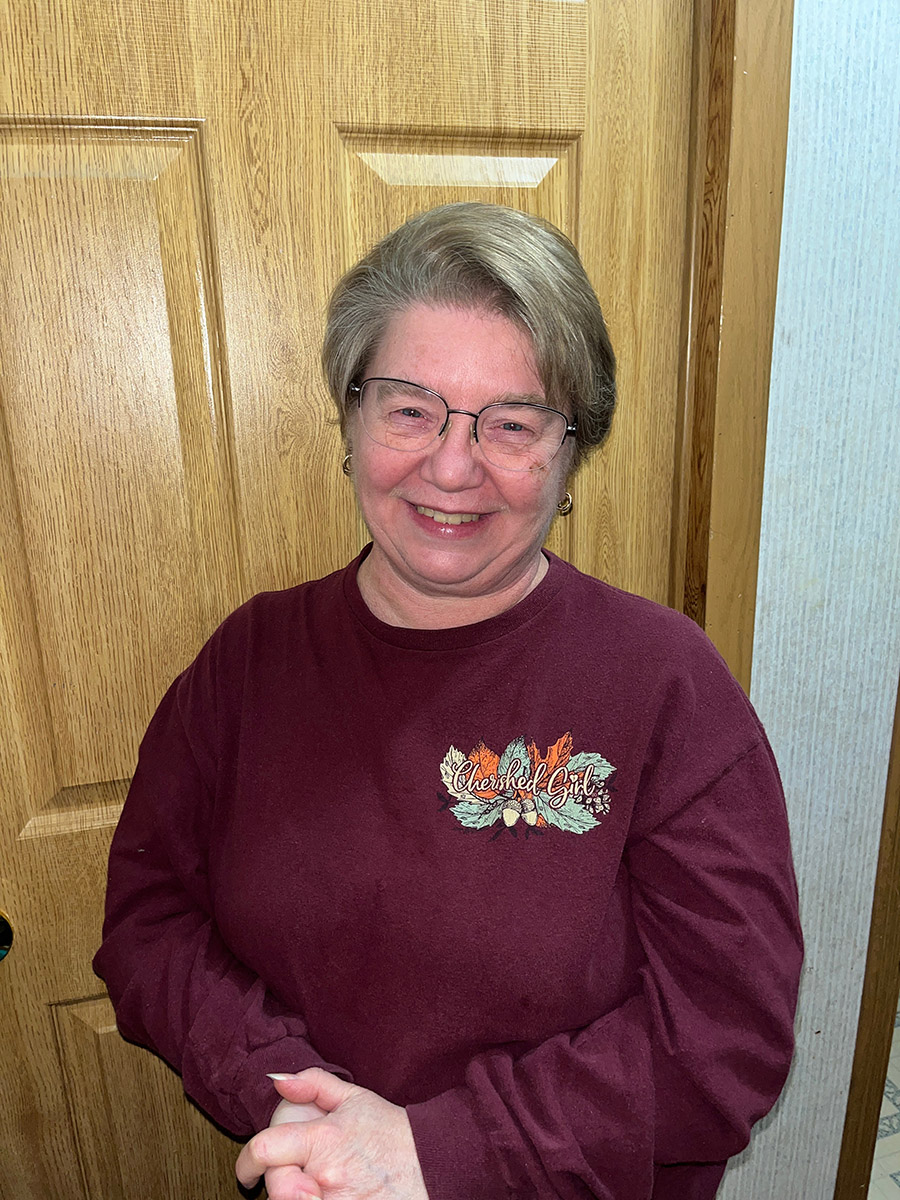
Karen Hill (Submitted photo)
Frances Smit
Special to the Catholic Herald
Organ donation had always attracted Karen Hill. From the first, her driver’s license has been stamped with a heart symbol for organ donor. She always wondered about donation, not after her passing – as her driver’s license indicated – but while alive and well. Yet, when her eight children were younger, she put off this thought to be available to them.
Her desire resurfaced when she heard on the news that a doctor in Minneapolis donated both his kidney and liver in one operation. She thought to herself, I should do that. The idea of organ donation, its feasibility now confirmed in the news clip, took root in her mind.
Living in western Wisconsin, she knew of the National Shrine of Our Lady of Champion Shrine near Green Bay. When she heard OLC Shrine would celebrate their first solemnity in October 2023, she knew the timing was opportune for her first visit.
In November, a newsletter arrived from OLC to join the shrine in a novena for the Solemnity of the Immaculate Conception. Karen’s novena became a question to Our Lady: Should I donate my organs? Can I do this?
At the end of her novena, she sensed the same message Our Lady had spoken to Adele Brise, the visionary nun of OLC:
“Do not fear. I am with you.”
Karen researched organ donations and found that 13 people die every day waiting for a donation. Could she reduce that number to 12?
Less than a month after her Immaculate Conception novena, Christmastime of 2024, she read Pope Francis’ announcement on the 2025 Jubilee year and its theme: Hope.
The Jubilee year timing and the message of hope ripened her idea. She could offer someone hope with a gift of herself.
Hurdles and doubts
“One of my biggest concerns was, I don’t have enough money. I can’t afford to do this. Then I was shown the way to the National Kidney Donor Fund and Donor Shield, which are two programs whose purpose is to help kidney donors and organ donors to be able to pay for their expenses.”
The programs paid for trips to the Mayo Clinic in Rochester, Minnesota, for testing and hotel stays for her and her husband.
The clinic performed multiple psychological assessments and checkups.
“Are you sure you want to do this?” The medical staff questioned her repeatedly. “This is a surgery that’s not easy to recover from. You’re going to be in terrible pain.”
She wondered, ‘Am I healthy enough? Am I thin enough?’
Karen’s 12-year-old daughter, her youngest, had responded to her announcement with, “God said you’ll be okay, so you’ll be okay.”
Then she panicked. What if her organ went to someone who had Nazi beliefs?
She decided she would not put conditions on the recipient of her organs. Her only condition would be to know the recipient’s surgery went well. No contact, no expectation or obligation from either party.
Then the difficult news: “Because of your age, you’re not a candidate for a double organ donation in one operation.” She would give one organ at a time, spaced at least one year apart, for her body to heal and regenerate.
Karen reflected, “I turned to Our Lady of Champion and her words: ‘Do not fear. I will help you. I am with you.’ I kept coming back to those words of hers and they lived in my heart.”
With renewed conviction, Karen charged ahead.
Carrying the cross of one’s yes
Cumbersome and invasive tests, such as a colonoscopy, mammogram, MRI, etc., were ordered to ensure there was no trace of cancer in Karen’s body.
The MRI, in particular, tested her resolve. Being claustrophobic, Karen found the MRI capsule walls encasing her a few millimeters from every surface of her body, exceptionally difficult.
Technicians had to keep stopping the test: “Mrs. Hill, you must stop moving.”
No longer able to allay anxiety by mouthing the words to the Hail Mary, she could only lie in silent panic while tears rolling from her eyes to her ears.
Three times from January to May 2025, she drove four-and-a-half hours from her house to OLC to pray for an hour, then drive home. Each time, her visit quelled her fears and doubts.
She was sure. The closer it got to the surgery date, the more excited Karen became.
A grateful heart
Karen articulates one reason for her organ donation decision: “I’ve received more intercession than I ever deserved.” She said of her eight children, three should technically not be alive.
One child developed meningitis as an infant, fatal in 40% of cases and even if a child recovers, the likelihood of long-term complications is nearly 60%. But her son is alive and well.
An accident caused a concussion so severe it wiped out her 14-year-old-daughter’s memory. Every morning was a reintroduction of her daughter to herself and to her family. Tests revealed she likely has Chronic Traumatic Encephalopathy caused by repeated sports concussions, but the diagnosis can only be confirmed after death through brain autopsy. Eventually, her daughter’s memory returned; she went on to earn a college degree and, despite some problems, she is doing well.
When Karen was pregnant with her youngest, her baby had managed to tie her umbilical cord into a perfect overhand knot and wasn’t getting oxygen. They performed an emergency C section. Karen’s OB/GYN said he’d “never seen a baby tied like that survive delivery.”
Surgery
Karen faced the surgery with joy.
At least a dozen members of the medical team – some for surgery, some for preparing her organ upon removal, some for transporting the organ from Rochester to Boston – all of them in the hallway outside of the operating room, covered head-to-toe in scrubs, looked like Smurfs to Karen.
Some Smurfs commented “We’ve never seen someone so happy for this operation.” Karen’s smile erupted into laughter.
She had waited a long time to do this; the day was finally here. Her plan was to do it again – that this surgery and recovery would go so well, it would set her up as the ideal candidate to donate her liver within a year.
She suggested to her surgical team that they put a zipper where her liver was, because guess what? “I’ll be back! And it would be easier for everyone involved if a zipper were installed outside my liver while you’re in the general area.”
She recovered from surgery in record time and was discharged the next morning, not needing to take any of the prescribed pain meds after surgery. Two days later, on Sunday, she sang in the choir at Mass.
The message of the Jubilee Year of Hope had tipped her decision to donate her kidney. It seemed fitting that she drive the distance to OLC’s Jubilee Mass of Hope celebration the following Sunday, July 20. Now, she has a date in mind for when to donate part of her liver.
