

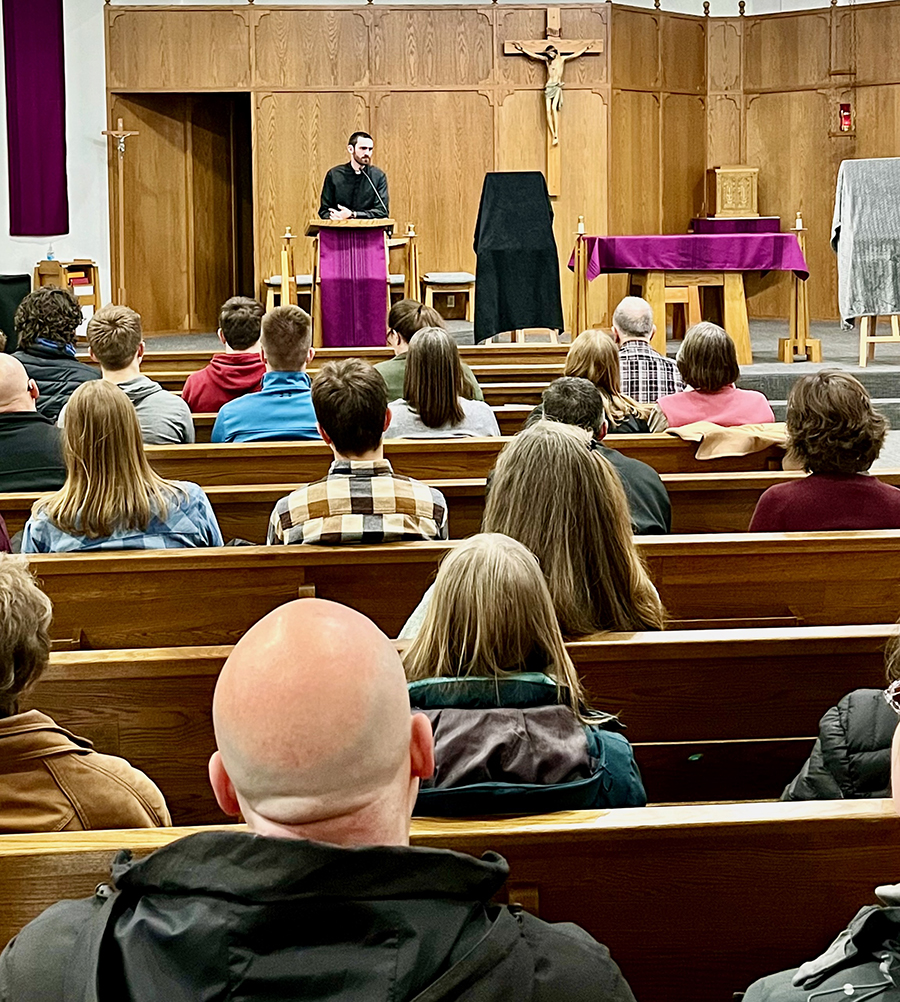
Your Content Goes HereFr. Isaiah Schick gave a two-day Lenten retreat at St. Francis de Sales, Spooner, on Feb. 27-28. (Catholic Herald photo by Jenny Snarski)
Jenny Snarski
Catholic Herald Staff
Over a two-evening Lenten retreat for the clustered parishes in Spooner, Shell Lake and Sarona, Fr. Isaiah Schick presented the season and practices of Lent going back to basics. Hosted the weekend of Feb. 27-28 at St. Joseph Church in Shell Lake, the retreat drew parishioners of all ages.
Why Lent?
Where did Lent come from, and what is its real purpose? The priest, who serves the clustered parishes in and around Rice Lake, answered during the first talk with etymology and the history behind the “churchy words” associated with Lent and Easter.
Fr. Schick explained Sunday was the earliest “feast day,” the weekly commemoration of Christ’s resurrection. Easter, in English, comes from Germanic and Old English words for the spring goddess and sunrise. This sunrise symbolically connects with the resurrection of Christ, but in the Romance languages the name for Easter—Pascua in Spanish, Pasqua in Italian—more directly connects to the Passover.
Easter is Christ’s Passover, and Fr. Isaiah drew on the imagery from both the Jewish Passover feast and the Sacrament of Baptism to expand an understanding of what we celebrate at Easter. Through the process of preparation and purification, paralleled with the 40 days and nights Noah was in the arc, the 40 years the Israelites were in the dessert and Jesus’ 40 days and nights before his public ministry, we intend to conform our lives more closely to Jesus’ life and what he has done for us.
The English word for Lent, which means “springtime” in Old English, is also different than in other languages. The Romance languages’ words relate to the 40-day period, whereas the Germanic word refers to spring and fasting.
It was explained that the Greek word for penance, a focus of Lent, is metanoia, or “conversion” in English. Fr. Isaiah pointed out that the exterior penances are really meant to foster interior conversion, and conversion is oriented towards the restoration of our hearts and minds to communion with God.
Return to the garden
For the second night of the retreat, Fr. Schick presented the three traditional Lenten practices in the context of the Garden of Eden. He said each was present in Genesis’ account of man’s original union and communion with God.
“A couple years into my priesthood,” he said, “the church has helped me re-rediscover Lent,” seeing prayer, fasting and almsgiving all “present from the very beginning” of God’s story with mankind.
The young priest said when people ask him about how to improve their prayer life, “My answer this year is different than in years past. I have no idea!”
He clarified that any human explanation of prayer falls short of God’s desire for relationship with us, a relationship that fundamentally defines prayer.
In the context of creation and the garden and prayer, the priest said, “God walked in the garden with Adam and Eve,” and that must have included conversation as well as moments of silence.
“It would be wearisome if [a relationship] was all talk,” and he gave the example of the shared quiet of enjoying something beautiful together. Prayer is also a relationship of trust where God wants to surprise us at times and challenge us at others. God doesn’t want to be our “last resort;” who we turn to “when we’ve exhausted all our own efforts.”
Prayer should also be understood as a mutual self-gift, Fr. Schick added, “the gift of your heart, body, soul and humanity to God, and the gift of his body, blood, soul and divinity to you.”
Offering practical tips for prayer, he encouraged listeners to involve their physical bodies, primarily through the sacraments. He said God made creation for us, to engage with us.
“When we only worship God in the woods, we forget that Jesus has a body,” he said. “There’s only one place on earth where you encounter God’s body – the Eucharist.”
He added that even if the homily is really boring, if we value the Eucharist as God’s gift, we allow Christ to literally communicate himself to us.
“If you’re wondering how to pray and you’re not living a sacramental life,” he added, “good luck.”
The sacramentals, he shared, are also a “treasure trove of things that help unite our souls to prayer,” although they are not magic charms or superstitions – they are connected to the sacraments and are meant to lead us to deeper participation in them. Holy water reminds us of our baptism and death. Death, he expounded on, is something we “practice” daily when we go to sleep. Sprinkling holy water on our pillow can be a profound moment of trust and surrender.
Sacramentals also include images and items and help us to remember God.
To combat forgetfulness, “outsmart yourselves,” the priest suggested. “If I’m awake, I want to have to have reminders of God in my surroundings.”
Fr. Schick then described the power of beauty, art and religious images as invitations to prayer. He uncovered a piece of art, the 18th-century painting “The Return of the Prodigal Son” by Pompeo Girolano Batoni. The priest described how while encountering the painting during a pilgrimage to Vienna, Austria, he could not turn his eyes away. It was as if “there I was, on the wall, and the heart of God” touched him.
He said the experience was unique but its impact has never left him, a testament to the power of prayer. We should remember experiences that can be difficult to put into words for moments of prayer and surrender to God in the present.
“He will speak as your heart understands and needs,” the priest shared, “as you make your heart available.”
He shared one other painting, William Bouguereau’s late-19th century “Pieta.” Along with that image was the suggestion to pray with God’s word, to “chew on it consistently;” in particular the psalms. He highlighted Psalm 144 in which King David, shepherd and warrior, can remind us that we, too, are training for war and battle when we pray.
“Our enemy knows he is at war,” he stated, “but we so easily forget … This world, this life, is the battlefield … When we forget that, it makes us sitting ducks … Yes, the battle belongs to the Lord, but it was David who slayed Goliath with those stones. So pray,” he said, “Here I am, Lord, do with me what you will.” Then don’t be surprised when that will points us to the cross, as “love conquers death, because God is love.”
Introducing almsgiving in the Eden context, Fr. Isaiah explained it as self-gift and an act of love. “It’s not dominion, but stewardship, over God’s creation and humanity,” as God entrusted to Adam. “It’s a participation in God’s creative love.”
He referenced an image put forth by St. John Chrysostom of “purses that do not wear out,” imagining the bellies of the poor as “heavenly treasure chests.”
Fr. Isaiah explained that the Greek word for almsgiving is the same as mercy, that Jesus “isn’t being metaphorical when he preached about the works of mercy.” These acts shouldn’t be carried out “to earn God’s love, but because you’ve already received the love of God.” They should be carried out concretely, locally whenever possible and offered for concrete intentions or people.
Where was fasting in the Garden of Eden? Before the Fall, when God said they were not to eat of the fruit of the Tree of the Knowledge of Good and Evil. Fr. Isaiah explained that the line “You can eat of any tree except” is misinterpreted as God setting humanity up for failure.
“That’s not how the early Christians understood it … It was a fast, and part of a relationship,” he noted how we are to fast outside of Lent. From eating before Mass, from sexual intimacy before marriage, “Because of the great goods we are about to receive.”
“It is a recognition that we are already, but not yet,” he said adding that there will be no fasting in heaven, and that fasting is focused on something even better than the good given up. Fasting increases our desire for the best goods. “What is the one thing it’s worth giving up everything for?” he asked. “God himself.”
Practically, he shared that fasting helps us to know where our spiritual enemies are. “If you’re fasting, it’s easy to see where the snake is” by what feels too hard, too tempting. Fasting shows us what things we are really attached to. Fasting helps us foster gratitude and the reminder that all things come from God.
Fasting goes well beyond food, he challenged. “We should fast from the things that we worship other than God… things we get resentful over when they are taken away” – vacation, downtime, entertainment, smartphones and social media. “It helps us focus back on the basics … relationships. We can replace all these ‘temptations’ with real relationships.”
If we’re trying to place ourselves into right relationship with God, then it makes sense that God is working towards that as well.
He ended the retreat with a story told by a missionary priest. He was visiting a mission church that was even poorer than the community where he lived and served. The people he was visiting were so excited to hear he was coming and when he arrived, they presented him with a small bag of rice.
“Here,” they said presenting about 3 lbs. of rice. “We want you to take this back to your people. We want to contribute to your mission.” The priest was overwhelmed by their generosity, especially when the resident missionary explained that those people had fasted for three months to collect, meal by meal, a few grains at a time.
“Blessed are the poor in spirit,” he concluded. “Don’t explain away Jesus’ words in your life.” He then invited participants to pray a Hail Mary, asking the Blessed Mother for the generosity to “live with the reckless abandonment she did. The courage to say, Jesus is going to come into my life. I have no idea what he wants to do with it, but I trust that it’s good.”
He prayed, “Give me the courage, Jesus, to say, ‘Let it be done to me according to your word. Not according to my anxiety… my worry… my plans… but according to your word because God, you are my Father; and Jesus, you are my Savior; and Holy Spirit, you are my life, and I trust you.”
Response
Madeline Roberts, a parishioner at St. Francis de Sales in Spooner, appreciated Fr. Schick’s focus – that it’s not about “checking boxes,” but understanding the history and context to help Catholics live Lent in a way that really leads to deeper conversion and isn’t simply set aside once Easter is celebrated.
Another attendee, Carmen Halvorson, also a St. Francis parishioner, felt the priest’s relatability, knowledge and vulnerability all contributed to the impact of what and how he spoke. She called the Friday night talk “a fireworks show of truth nuggets.”
