

In the book “The Way of Beauty,” by David Clayton, he explains that sacred art has a definite purpose in a Christian’s world. He says, “For the Christian, the highest art is that which supports the highest purpose: the worship of God in the sacred liturgy” (4).
What is sacred art?
Some examples of this form of art take the shape of stained glass windows, tapestries, icons, sculptures, paintings, and architecture. To Christians, this art is not unfamiliar. It might make a lasting impact on us while we sit in pews on Sundays, but how can it affect people outside of Christianity?
On Nov. 18, I attended a talk put on by the University of St. Thomas in Minnesota. The talk was part of a series called “Echoes of the Eternal,” and this was Episode 18: Sacred Arts. The presentation was done in an interview style, led by facilitator Charlie Treacy, featuring a local iconographer, Nicholas Markell. The discussion centered on iconography, its process, and the prayerful/thoughtful way icons are constructed with divinity in mind.
I had the opportunity to interview Jacob Benda, the director of Music, Liturgy & Sacred Arts at the Chapel of Saint Thomas Aquinas at the University of Saint Thomas, how he thought that sacred art could inspire all kinds of people, not only Christians. He told me he believes that sacred art takes one out of the finite and into the infinite. He also mentioned how sacred art can allow one to “thirst for the transcendent.” Although everyone who encounters sacred art won’t be all Catholic (or even Christian), by encountering a Christian piece, they can realize and even appreciate its divine inspiration.
Similarly, when asked the same question, Treacy spoke to the encounter that sacred art can bring to a person. He mentioned it has the ability to “take you outside of yourself.” He said, “Sacred art provokes an encounter that you take on its own terms.”
In the book, “How Catholic Art Saved the Faith,” by Elizabeth Lev, she outlines how painters used their craft to believe in the presence of the Eucharist.
“Brandishing brushes, girded with personal faith, and flanked by theologians, artists labored to ignite the imagination and deepen devotion to the Eucharist” (29). An example of this that Lev uses is the artist Andrea del Sarto. She explains that his painting, “Lamentation over the Dead Christ,” uses rich color and symbolism, but at the center of the painting is Jesus Christ laying on stone, a chalice right beside him with a gold paten and host (31). The proximity of Jesus and the chalice with the host points to the powerful mystery of transubstantiation, and the viewer is better able to comprehend the sacrifice of the Mass in such a visual way. The work is an example of how artists have the ability to lead viewers to understanding of subjects with which people may struggle. A painting like this impacts Christians and non-Christians alike in the sense that its mission is to aid in understanding, if not total acceptance, of what is being depicted.
Think about the impact the Sistine Chapel has had since its construction had for the world, and the visitors it attracts in awe of its magnificence. In the article, “The Sistine Chapel: How Perspectives Shift Over 500 Years,” by Emma Livingston, the author explains that Michelangelo’s work was transformative in the way that it pushed social boundaries in how Catholic art was depicted in the 1500s. Only a little more than 500 clergy originally saw Michelangelo’s “Last Judgement,” and Livingston explains that their reactions were mixed, as they hadn’t seen art depicted in this way before. Michelangelo’s adaptation of sacred art lives on as an inspiration for everyone, in the way people view and create art and also how they can encounter sacred art.
Sacred art has, and continues to, inspire those outside and inside of churches. It is an experience that all are welcome to encounter and can take something from, even if it’s just a recognition of the otherworldly, or in “The Lamentation of Christ,” can be used to understand specific truths one may believe in. As Treacy had said, it provides an experience in which you aren’t so much focused on yourself, but are pointed upward, whether that be in the design of the piece or the inspiration behind it.
Sophie Kolars is the communications coordinator at St. Bridget, River Falls. She has a degree in Journalism & Communications from Benedictine College.
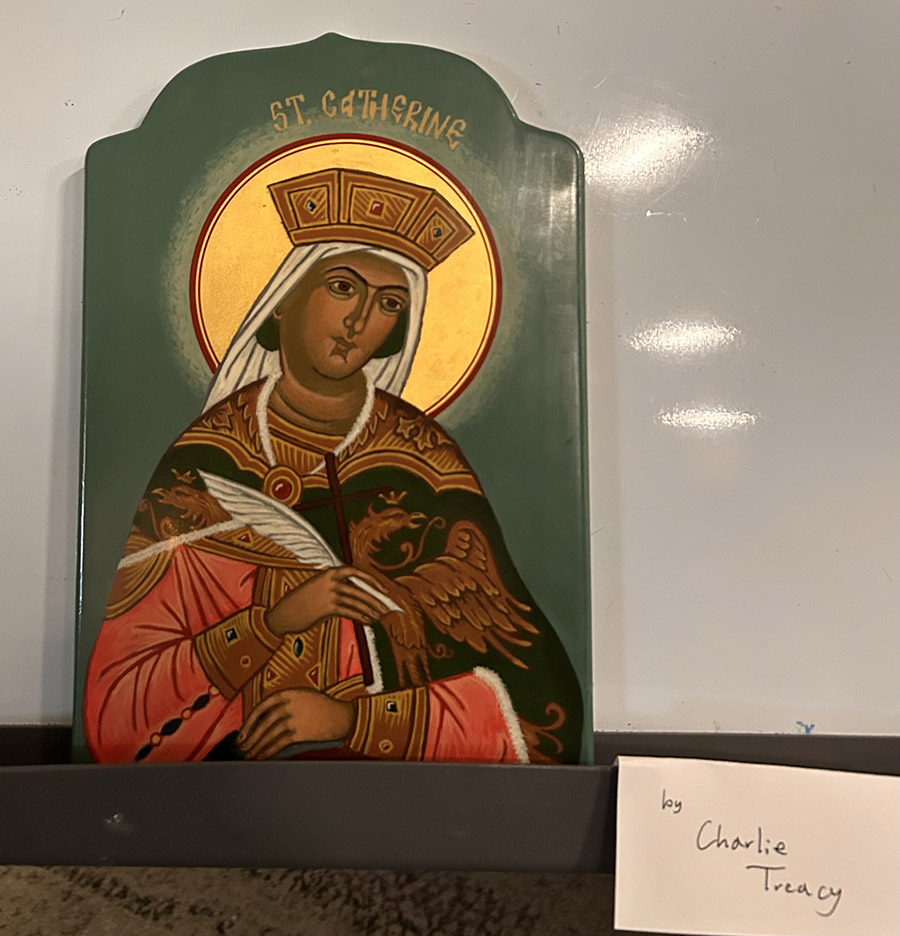
Icon by Charlie Treacy (Photo by Sophie Kolars)
