

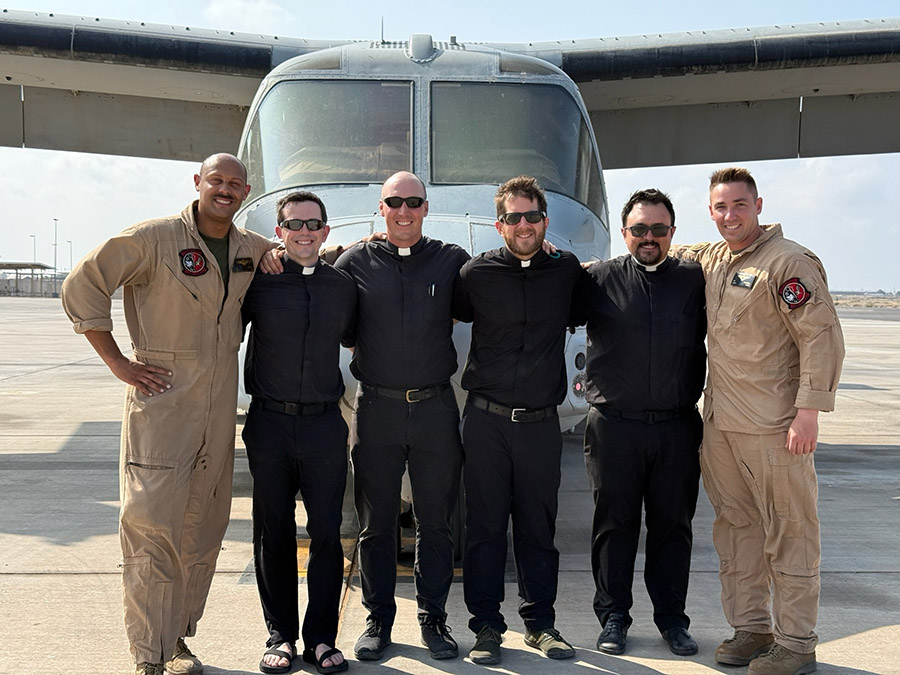
After celebrating Sunday Mass at Camp Lemonnier, Frs. David Neuschwander, Samuel Schneider, Adam Laski and Patrick McConnell were invited by pilots Captain Carlos Rodriguez, USMC, and Captain CJ Russell, USMC, to see the V-22 Osprey. (Submitted photo)
Fr. Samuel Schneider
Editor’s Note: This is a submission from Fr. Schneider, who was ordained for the Diocese of Superior, co-sponsored by the Archdiocese for the Military Services, in June 2017. He is currently serving as a U.S. Navy Chaplain deployed in Djibouti, East Africa, at the southern end of the Red Sea.
“Behold, how good and pleasant it is when brothers dwell in unity!” — Psalm 133
One of the most common fears people express about the priesthood is the fear of celibacy—often imagined as isolation—as if marriage were the only way to be known and loved. But life teaches a more honest truth: loneliness isn’t cured by proximity or vows; it’s healed by communion, by being known and loved within a shared life and a shared mission. Sometimes that communion is in marriage, but sometimes it is in Christian brothers and sisters.
That truth came into sharp focus in December, when Fr. Patrick McConnell, Fr. David Neuschwander and Fr. Adam Laski traveled from the Diocese of Superior to visit me in Djibouti, on the Horn of Africa, where I’m serving while deployed with the U.S. Navy at Camp Lemonnier. One fellow chaplain remarked, “I don’t think I have anyone who would travel all the way here just to visit me,” and I have three!
My brother priests were welcomed immediately into the local church as they had previously welcomed me. The Diocese of Djibouti, serving a small community of immigrants and the poor, housed them on its grounds and lent us a vehicle for the week. This generosity didn’t come from surplus but from love. Fraternity, we saw, isn’t about convenience—it’s something chosen and lived.
Our days took their shape from prayer with Mass as the center; a shared Holy Hour anchored each day in silence before the Lord. Communion begins by turning to God together.
Being far from parish life made all this possible in a rare way. No calls. No emergencies. Nothing pulling us in different directions. We didn’t need to be “on.” We could just be brothers. It wasn’t an escape, it was a retreat and, in the military sense, a retreat is not a surrender. It’s a movement with purpose—to regroup, to resupply and to re-engage.
On our second day together, we drove north to Tadjourah. The countryside is both desolate and beautiful—scattered huts and cattle, herds of camels and goats wandering through towns. The environment is best described as foreign, raw, unpredictable and alive.
In Tadjourah, we fished, prayed, and visited Fr. Mark Desser, an American priest ordained for the Diocese of Mogadishu in Somalia. He now serves in Djibouti where he runs a vocational school that trains young Djiboutians in the trades. His faithful Catholic presence in a Muslim country, tucked between the desert and the sea, reminded us of St. Charles de Foucauld—a fidelity that remains not for acclaim, but because Christ commands.
Like any family on a long trip, we had our moments when tensions surfaced and personalities clashed; but real fraternity isn’t sentimental, it is resilient. It means staying in the room, forgiving and choosing each other again. It’s being known and loved not just for your gifts, but in your weaknesses.
Over the week of my brother-priests’ visit, we met clergy from Palestine, India, Kenya, Italy, Romania and France. The bishop here often says more languages are spoken in his cathedral than were heard at Pentecost. Yet across cultures and personalities, fraternity runs deep. Our unity was grounded in the priesthood and love for Christ.
One unforgettable moment came at Lac Assal, the lowest point in Africa. Its salt content is so high, it’s nearly impossible to sink. You float whether trying to or not. And that’s how fraternity works: in the lowest places, you’re carried by a bond deeper than any struggle—shared life.
In times of priest shortages and heavy workloads, priests can feel like lone wolves—faithful, but isolated. Yet Christ sent his disciples two by two. The most fruitful ministry I’ve known—and the most powerful witness to vocation—has always grown from joyful fraternity.
With the visit over, the gift remains. Our bonds were strengthened. Our fraternity renewed. Rooted in our common mission and shared priesthood in the Diocese of Superior, we were reminded that we belong to one another.
Please pray for and support your priest’s prayer and his relationships with brother priests. It strengthens him to be a more faithful instrument of grace. We want to give generously but we can’t give what we haven’t received. If you want a fruitful and holy church, pray for fraternity among her priests.
How good it is—how necessary it is—when brothers dwell in unity!
