

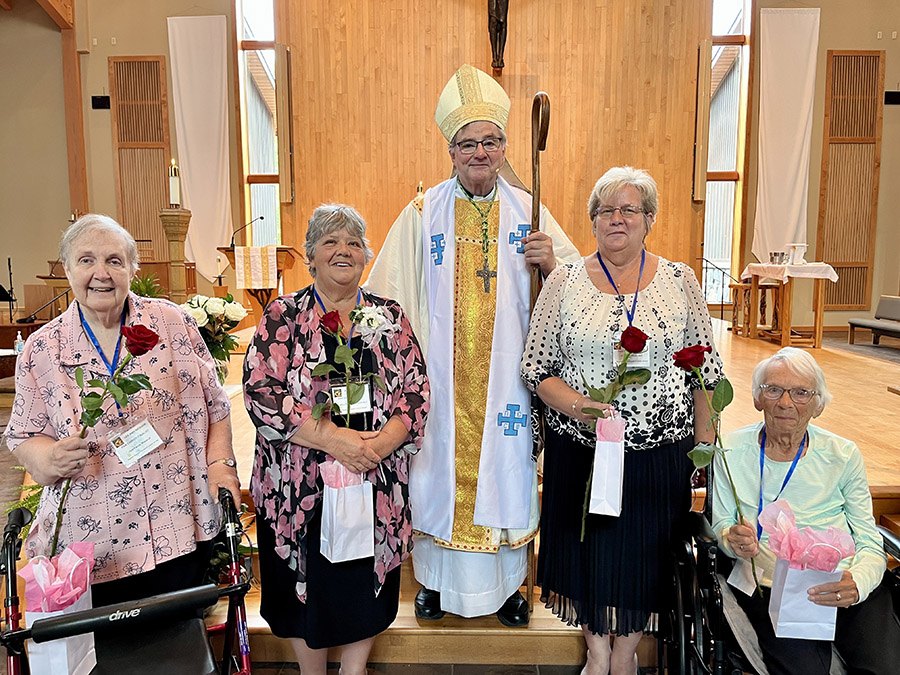
The four finalists for the SDCCW’s annual Pax Christi Award stand with Bishop James P. Powers. They are Lee Ann Niebuhr, Holy Family in Woodruff; Karleen Sperl, Sacred Heart in Stetsonville; Theresa Nordell, St. Ann in Turtle Lake; and Constance Uhlig, Most Precious Blood in Glidden. (Catholic Herald photo by Jenny Snarski)
Jenny Snarski
Catholic Herald Staff
Holy Family Church in Woodruff hosted the 75th Annual Superior Diocesan Council of Catholic Women’s Convention on July 31 to Aug 1 with the theme, “Opening the Door to Women of Faith.”
On Thursday evening, following a board meeting and banquet, Pat Pintens presented on prayer as the “Key to the Door of Faith.”
Nationally known speaker and author Emily Stimpson Chapman gave the convention’s keynote address Friday morning on the unshakeable and world-changing faith of two female saints.
Stimpson Chapman’s introduction focused on what it means to be “captivated by Christ.” Defining a saint as someone captivated by Christ who strives to live a life centered on him, she said her subjects were “captivated by Christ in an era that is not unlike our own,” and it was their fidelity to him that bore such tremendous fruit from their prayer and work for the church.
Born into a time “rife with chaos,” 14th century saint Catherine of Siena was born under the shadows of the Black Plague sweeping through Europe and the pope living in Avignon, France, because of the chaos in Rome, Stimpson Chapman reflected.
With the saint’s first mystical experience at the age of 5, by 7 she had consecrated her life to Christ, although the decision was opposed by her parents. At 13, she began to live like a hermit in her family home with Jesus and Mary as her sole companions. God called her to serve her immediate family, then the local poor. It was hearing about her holiness that prompted the pope to seek her out; the friendship that developed was then used by the Holy Spirit, prompting Catherine to persuade the Holy Father to return to the rightful See of Peter in Rome. Catherine was only 33 when she died.
Living more than 80 years, Germany’s St. Hildegard lived in the 12th century, another period of great upheaval in the church. With multiple claims on the papacy and bishops not living out poverty or chastity, Hildegard became an abbess of her religious community in her 40s. She composed beautiful hymns, recorded tremendous visions she had and received invitations from bishops to preach in their cathedrals. She was also sought out by the pope.
Connecting the lives and times of these saints, Stimpson Chapman focused on how it was “in the midst of a struggling church and culture” that they responded to God’s call and became saints. She continued to present four lessons about holiness that can be learned from these women.
First, holiness is surprising, not usually looking like we would expect. In Catherine’s case, she was neither a nun or a dedicated wife. She lived as a consecrated lay woman and responding to Christ’s call led her life along very unexpected paths. Her only concern was fulfilling the specific mission with which she was entrusted day by day. For Hildegard, who had a strong and feisty temperament, God called her to continual growth but worked with who she was.
The speaker noted how this reaffirms “there is not one mold” for holiness, but “every person is the mold.”
“It’s the stuff that’s not you that he wants to strip away,” she said. “God didn’t make you to be a generic saint, but a particular one.
“We can’t do sainthood the way it’s been done before … We have to listen to his voice and discern his call,” knowing that the heart of sainthood “is the same – someone who loves Jesus more than anyone and says ‘yes’ to God” on sunny days and in storms.
Secondly, Stimpson Chapman observed that sainthood requires patience. Sainthood doesn’t happen overnight. For Hildegard, “it was an ever-so-slow transformation,” she emphasized, commenting on the woman’s struggle to control her temper and admit her wrongs, learning to respond to situations and people with grace. “We all need to learn to see ourselves in the gentle mirror of Jesus … To see everything that Jesus is but also his love … finding balance between acceptance and striving.
The third point was that sainthood requires suffering. “Holiness is born on Calvary,” Stimpson Chapman asserted. “As Christians, we are called to be conformed to Christ,” she said and recounted ways that both women suffered very much being mocked, belittled, grief-stricken, betrayed and enduring physical ailments.
She said it can be tempting to write off their struggles, clarifying it was by their endurance and clinging to Christ that they became holy and received more grace. They didn’t suffer well because they were saints; rather, “they became saints because they suffered well. They said ‘yes’ so often that the devil just couldn’t move them,” and “that is how they changed the world,” she stated.
Finally, the author and speaker, who also shared personal stories about her struggle with anxiety, an eating disorder, infertility and journey to motherhood through adoption, invited her audience to see the transformation in the world that holiness brings about. “It is the only solution to the chaos in the world,” Stimpson Chapman said, “becoming saints ourselves. We have to become the women that Christ needs us to be.”
Related to this, she commented on the outrage and anger so dominant in our world, confirming that “it is okay to feel outrage before outrageous things,” but giving in to outrage is often easier than actually doing the right thing. Referring to Catherine of Siena’s choice to live a secluded, silent life, she said the saint “didn’t get the life she wanted, but the life Christ called her to,” and that ultimately, it was her holiness and faithfulness to Christ to drew others to her.
“If we want to help our hurting world, we have to say ‘yes’ to Christ day in and day out, denying our will and choosing his,” Stimpson Chapman concluded. “We have to allow him to root out hurts and sins and passions. We have to say ‘yes’ to our daily crosses, to trust that he takes all the suffering, joins it to his own and uses it to heal the broken world.”
Speaking out of her life’s experiences, she acknowledged, “Giving him trust doesn’t make everything magically better,” and shared how much “great hope” Hildegard’s life gives her. “God has a plan for you. He has a mission for you – nobody else in this room can do the thing he asks you to do.”
After her presentation and during subsequent breaks, Stimpson Chapman, whose husband and three young children accompanied her to Woodruff, spoke with convention participants, sold and signed books.
Some of her notable works are three children’s books written with Dr. Scott Hahn, “The Catholic Table,” “Hope to Die,” “These Beautiful Bones,” and “The Catholic Girl’s Survival Guide for the Single Years.” Her latest book will release this fall with Word on Fire’s Votive imprint. “The Story of All Stories” is an illustrated story Bible with an accompanying audiobook narrated by Jonathan Roumie.
SDCCW past-president Jane Schiszek was presented as the president-elect for the National Council of Catholic Women and, as current province director, gave a message.
Eight young women were recognized as Golden Rose recipients for their example of the CCW’s mission traits of spirituality, leadership and service. They are Madison Anderson and Ashley Johnson of Our Lady of the Lakes in Balsam Lake; Hannah Bender of St. Theresa in Three Lakes; Kaylee Cornelius and Malia Szews of St. Kunegunda in Sugar Camp; Rachel Daniels of Holy Rosary in Medford; Ava Stanley of Our Lady of the Lake in Ashland; and Carolin Waldal of St. Patrick in Hudson.
During the Mass, newly appointed SDCCW spiritual director Dcn. Mel Riel of New Richmond proclaimed the Gospel.
In his homily, Bishop James P. Powers preached on faith and openness to the gift of faith wherever we find it and in the unexpected people and places it might find us. Speaking to Matthew’s Gospel analogies of salt and light, the bishop stated the nowhere in the Scripture does God tell us to deny our gifts or not to share them with others. “He calls us to grow them” as part of our path to holiness. He spoke about the need for prayer and silence to develop a relationship of trust with the Lord.
Bishop Powers added, referencing the current Jubilee Year of Hope, “If we place our hope in things or other people we’re going to be disappointed. The only hope that never changes or disappoints is that love of God, his mercy, and that’s what we have to offer.” He affirmed the transformative truth of the Eucharist they would take part in at the altar, and invited those present to open their hearts to God’s great gift, “that we allow that gift to change and transform us,” and to “rejoice always that our God has first loved us that we might love him.”
Before the Mass’s recessional, the four Pax Christi Award finalists were called forward and acknowledged for their dedication and service. A total of 13 nominations were submitted from four of the five diocesan deaneries. Finalists were Theresa Nordell from St. Ann’s Parish in Turtle Lake; Karleen Sperl from Sacred Heart Parish in Stetsonville; Constance Uhlig from Most Precious Blood in Glidden; and Lee Ann Niebuhr from Holy Family Parish in Woodruff, who was honored with the Pax Christi Award for 2025.
After lunch, Bishop Powers invited the women to learn and live a new “formula” that he had heard at the Knights of Columbus State Convention: That is, to know the story, live the story, love the story and tell the story.
He addressed some current talks around the diocese regarding important reorganization efforts. “We are not closing any parishes,” he said, adding that parameters are being established that churches will have to meet to maintain their active parish statues. He said the four steps offered should help declining churches rebuild.
“For Catholics, the story is the same. The story we need to know is the story of our salvation, of God’s love for us,” he said.” “The story of the second person of the Trinity taking on flesh, being born of Mary, living 33 years and offering his life on the cross.
“We’ve been talking about evangelization for four years. The last five popes have called us to claim our evangelical mission.” He continued, “There’s no way we can do it if we don’t know the story. No way we can do it if we don’t love or live the story. As important as those three are, what good does it do if we don’t tell it? Jesus never said, ‘go save yourself.’”
The bishop added that evangelization isn’t a new concept. That many of the stories of CCW members are just this, and that those stories need to be shared as examples. “If we know our history, how can we help but love it?” He said, “That’s who we are, who we’re called to be. There’s not a one of use who’s not called to be an evangelist – which means know, live, love and tell.”
He introduced Matthew Kelly’s “33 Days of Eucharistic Glory” as a program he would be rolling out to the entire diocese and spoke of how many solid faith formation tools are available.
“We have all had an encounter with the Lord God, or we wouldn’t be here,” he said. “Why don’t we share that? … It’s a big part of who we’re called to be.
“As a CCW, please wave your banner. I’ve been begging the Knights, too. If our young people don’t see that it’s important to us, how will it become important to them,” he added, saying that they are not hearing the message from the world.
He concluded thanking for them for all their service, prayers and dedication. He concluded, “Please, take that formula to heart. Together, let us grow the diocese.”
Dcn. Riel echoed much of Bishop Powers’ message in his words. He thanked the bishop for entrusting him with this new role and iterated, “The church exists to evangelize. We exist to evangelize.” He affirmed the call to holiness and mission; similar to our faith, the Eucharist is a gift that we can’t keep to ourselves.
“We don’t have to know all the catechism,” he said, “but need to share the effects of faith in our life. We can be great disciples, but we have to take that one more step toward missionary discipleship.”
